 Digital ad players from AOL to Facebook have given lead-gen ads a try, but one company built an entire business around it.
Fluent has remained relatively quiet since it was acquired by information services company IDI, now Cogint, for $100 million in cash. The company was on a $140 million (gross revenue) run rate at the time of that deal.
Fluent’s bread-and-butter business is helping database marketers navigate their CRM and email channels. Its next move is to tap online behavioral data to support more acquisition marketing use cases.
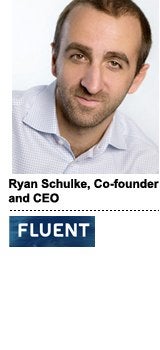
“To think about a segment only through the lens of having someone’s email address is not where the market will be five years from now,” said Ryan Schulke, co-founder and CEO of Fluent. “People are thinking more omnichannel instead of ‘Oh, I have a CRM strategy, a digital, television, print and outdoor strategy.’”
Commercial brands ranging from Shoe Carnival and Finish Line to Overstock.com use Fluent’s audience segmentation tools to identify high-value prospects.
For instance, Shoe Carnival might want to identify new digital leads for its shoe loyalty program without cannibalizing in-store sign-ups.

 After identifying existing customers by digesting the retailer’s CRM list, Fluent might run a performance campaign offering nonmembers 20% off of their first order when they sign up for the Shoe Perks program.
Although marketers can already build custom audiences on Facebook or through Google Customer Match, Schulke claims Fluent can extend those user matches across the rest of the web – or to older demos, for instance, that might be harder to reach on Facebook.
That’s because Fluent powers consumer shopping surveys that it serves to more than 500,000 US consumers per day, the company claims. Fluent works with both third-party publishers and maintains its own shopper survey network, which is geared toward consumers who are searching for loyalty rewards, coupons or other offers.
An apparel vertical survey, for instance, might ask the consumer how many times per year they shop for clothing or whether they prefer Brand A or B for footwear.
Although one could argue that consumers who are in search of deep discounts don’t always signal “high lifetime value” to a brand, Fluent claims that by combining that “real-time” survey data with other data sources, such as CRM or third-party data, a marketer is able to round out a consumer’s profile.
Stemming from its survey apparatus is a database called AudienceNow.
Fluent says that AudienceNow contains 150 million unique email addresses, tying back to more than 63 million households. Last winter, it started to activate this data set more programmatically by partnering with LiveRamp.
Marketers who already onboard third-party segments via LiveRamp parent Acxiom can tap into Fluent’s first-party survey data for their existing customer acquisition campaigns.
At 100 employees, Fluent, which is a fully managed service, hopes to capture some of the dollars that are flowing into media and CRM agencies.
“Companies like Acxiom are trying to be agnostic and build the piping to power people-based marketing. But we don’t compete with them as much as we complement them,” Schulke said. “[We might compete with] Merkle to a degree, or to a Criteo with this focus of always-on performance revenue.”
If the lines continue to blur between traditional loyalty programs and channels like search and display, Schulke predicts traditional retargeting will benefit.
“Retargeting is really most effective when you understand recency and understand that a customer does not always make a decision on that first run,” he said. “Better attribution is something we need to keep thinking about.”
Clarification: IDI’s acquisition of Fluent included $100 million in cash, as stated above, with $125 million in IDI (now Cogint) stock for a total transaction deal value of $225 million.