

 Greater automation in TV introduces more nuances to the viewability debate, in addition to maintaining the right frequency of ads to content.
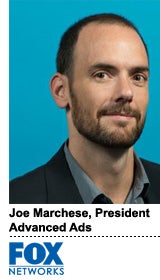
Just ask Joe Marchese, the newly appointed president of advanced advertising for Fox Networks Group. His promotion follows 21st Century Fox’s acquisition of the interactive video ad platform true[X], which he oversaw, in December. In addition to the standalone true[X] business he’s heading, Marchese is exploring ad products to accommodate the changing role of television advertising in an on-demand environment.
“It’s something that’s yet to be figured out, but it’s not going to be injecting the same commercial load into an on-demand format,” he said.
To that end, true[X] developed an interactive mid-roll replacement unit, which midway through a video prompts the user to engage with a 30-second ad in exchange for an ad opt-out for a select number of minutes.
Formats that give consumers options do double duty for marketers, since a user selecting the 30-second mid-roll ad vs. a longer format that mimics a traditional commercial ad break, proves it was viewed by a human. Thus, it could encourage traditional media owners to relinquish more inventory to automated channels, since broadcasters can prove engagement and price accordingly.
Marchese spoke with AdExchanger.
AdExchanger: Why did 21st Century Fox buy true[X]?
JOE MARCHESE: Our interests aligned with theirs. True[X] will remain a standalone division because the goal is to have something that will serve the entire industry. In a digital, on-demand world where ad avoidance is a growing trend, there’s a flood of impressions coming from different players in the market. There has to be a different currency or approach, where there’s something that values quality over quantity.

The present currency for an impression is a rather low bar – half the ad for two seconds – that currency will never work for [network] advertisers. Why is half an ad that’s viewable for two seconds equal to an impression that’s viewable for 30 seconds on the entire screen? Anyone can tell you those two things are not equal.
What is a more level playing field?
An impression is only the potential for attention. Everyone knows not everyone sees an ad, but when we degrade the definition of an impression to so little that there’s barely even the potential for attention, you have a problem. If we can shift from “the potential for attention,” which is why we have to run such a high frequency of ads, to actual attention, it benefits the consumer and the advertiser doesn’t have to run [ads at the same] frequency. I think anyone who tries to fight the idea that more viewability in ads is a good thing probably doesn’t have very good ads. The big move going forward will be to come to a better standard that values people’s time and attention.
What’s the biggest challenge?
All of the disparate platforms. How are people going to get access to content? Interacting with an ad asset on your television is very different than interacting with an ad on your iPad or your phone. And even on your phone, is it iOS or Android?
Speaking of ad loads, despite the growth in sports and news live-streaming, the ad experience is still a bit of a mess.
This goes back to the discussion about a new currency. As long as an impression is the currency and the prices are so depressed, ad loads remain high. Good, quality content has a price to it and the ad load is reflective of the cost of content. So it could be free, ad supported for the consumer or at least subsidized. Second, we need … rich, interactive creative so a single message could deliver the message recall and impact of passive ads. That’s not only possible, but we’ve found you can exceed [the impact of seven to 10 linear ads] in one engaged session in digital video with a consumer.
Are these the types of issues you’re tasked with solving at Fox?
What I’m most excited about is finding a way to make ads time- and place-shifted, rather than interruptive. What if people could spend time with advertising on their own time, whether on the train or in line at the store, and then go home and watch TV commercial-free? Is that going to happen tomorrow? No, but great advertising always matches the medium. The perfect ad format for TV is commercials. I think a lot of people in tech throw stones at TV and don’t understand how well it works, but if the consumer moves to an interactive, on-demand experience, we’re looking at how do we make the ads interactive and on-demand as well.
What about the role of data in crafting a better ad experience?
You’re seeing a lot of [television] networks look at their first-party data as key moving forward – the fact that we know who our audience is at the end of the day. That’s the most important part in creating a data strategy and it will allow you to have a better ad experience and see less ads overall. The more targeted they are, the less volume we have to show. That value proposition needs to find its way to the consumer so the consumer opts in, [which] is a much better state of being.
As more content producers unbundle, what happens to networks that don’t unpack their content?
I think the bundle gets a bad rap because it’s so easy to pick on. Why am I paying for 150 channels when I only use seven? That’s like saying why do I pay for the gym when I only use six of the machines? Winston Churchill said, “Democracy is the absolute worst form of government except for all of those others,” and I think you can apply that to the bundle. It’s the worst form of paying for content other than all the other ones. It’s pure economics. Providing the ability for consumers to go a la carte is fine, but if you start adding up the numbers, it gets pretty expensive pretty quick and then you end up with less choice.
If people are happy with the service they get, and if people could get content they wanted wherever and whenever they wanted, and if TV was truly everywhere, you’d see a lot less issues with the bundle as it is.






