 “Upfront” presentations are intended to get advertisers to spend money on networks’ programming, but YouTube parent Google will be the initial big marketer on the video site’s new content channels. At the company’s big “Brandcast” event, the search giant pledged $200 million in advertising across YouTube and the Google Display Network to promote the video site’s more professional content channels, which include the TeamUSA channel, featuring videos from the U.S. Olympic Committee, and Tribeca Entertainment’s forthcoming The Picture Show, and gaming showcase Machinima, among others.
Robert Kyncl, YouTube’s global head of content, told reporters Wednesday that by the end of July there will be 25 hours of new original content on YouTube each day. And while Google is spending lavishly to attract viewers and advertisers, marketers lined up at New York’s Beacon Theater on Wednesday night for the Brandcast to take a look at what YouTube is offering. “We’re hosting 1,000 plus marketers to show them what we’ve done,” Kyncl said.
Since announcing plans last fall for 100 professional content channels that are meant to evolve YouTube into the online, solely ad-supported equivalent of a cable TV provider, Kyncl noted that between 40 and 50 channels have been fully up and running. “We’re launching channels every week,” he said.
Nevertheless, during a press conference, Google and YouTube executives still wouldn’t let on about whether the video site is indeed self-supporting and how much revenue it expects to generate from the new channels.

Though last night’s event had the appearance of a TV-like ad presentation, the video site’s model is aiming at something a little different. “TV networks focus on discrete pieces of content,” Kyncl said. “We want to get YouTube out of the way and we behave more like a distributor.”
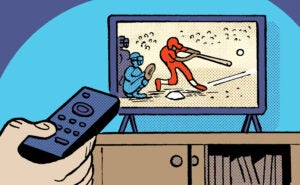
One way to read that quote is to note that YouTube, even with its vast scale of 800 million global users, still needs the TV networks to supply some of its content. So Kyncl and the other executives were careful to note that they see YouTube as a complement to TV viewing. That’s especially true for Google, which is still trying to build up its Google TV over-the-top offering.
“We don’t see what we’re doing as a replacement for TV, we see it as augmentation,” said Google Chairman Eric Schmidt. “New TVs have direct to Netflix and YouTube buttons and new generations will include Google TV, which is a platform for manipulating video. As a content provider, YouTube is a global distribution channel that has different economics and requires different kinds of partnerships. The existing models continue and the new model is where the traditional models are not available, especially overseas.”
To serve that function, Google and YouTube will have to continue to prove their benefits to blue chip marketers. Lucas Watson, VP, global video sales, YouTube, boasted that “98 out of the 100 largest brands advertise on YouTube,” adding that “we’re continuing to work on the other two.”
Among the marketers supporting the new channels, Watson mentioned AT&T, GM, Toyota. In terms of the specific value YouTube offers marketers, Watson said, “We see huge potential in a opening up a wider social and community aspect for advertising, with social amplification, and less focus on text and other formats that are typical of advertising on the web.”
In particular, Watson pointed to YouTube’s TruView ad formats, which, similar to Hulu’s Ad Selector, lets users avoid ads they’d rather not see in place of ones that might present a bit more affinity and engagement.
“At YouTube, we’re not just reimagining video, we’re reimagining brand-building on the web,” Watson said. All well and good, but given the amount of money and energy of last week’s NewFront fetes by AOL, Yahoo, Microsoft and Hulu, YouTube isn’t the only one and there are only so many ad dollars to go around.