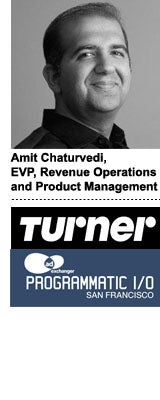
 Amit Chaturvedi, EVP of revenue and operations and product management for Turner, will speak at AdExchanger’s Programmatic IO conference on April 10-11 at the Marriott Marquis in San Francisco.
At Turner, Amit Chaturvedi’s job is to support ad sales and drive revenue.
He’s the guy responsible for vetting vendor partners and building a stack to ensure the broadcaster has the proper tech infrastructure to deliver content in emerging channels.
“There are a bunch of teams supporting me, including analytics, ad operations and account management, but the broadest way to define my role is the delivery of ad dollars and all of the associated plumbing that goes with it,” he said.
Chaturvedi spoke with AdExchanger about how Turner builds its business plans on the basis of a good user experience.
AdExchanger: How does building an ad stack and monetization strategy for news, like CNN, differ than live sports, like the NBA playoffs and March Madness?
AMIT CHATURVEDI: A news publisher like CNN has a ton of scale, but the content we’re publishing is so diverse. On CNN you have 120 million uniques across all these different platforms, so it’s literally all of America tuning in.
So audience-based targeting on CNN is likely going to come from a demand standpoint, and advertisers are going to ask for [inventory] much earlier and more frequently than in sports.
Sports is almost in a class of its own because you’re selling a lifestyle and people have strong affinities to teams.

Marketers want contextual alignment against key tent pole events like NBA playoffs and March Madness. That’s very different than mass market news where the asks will come much more frequently for audience targeting and programmatic execution.
How do you ensure your tech partners are equipped to handle these different demands?
We used to be in a place where one point solution helped us solve [a] very specific problem. Over the last couple of years [we’ve moved toward] talking about the issues that could come up in the next 12-18 months, and that has led to more strategic road map questions.
Ad tech and mar tech is still in its infancy, but the pace of change is so great. And if you’re not transparent with internal and external partners, you’re really just limiting the pace of innovation.
Given that rate of change, how does Turner monetize new channels like OTT?
Video is video is video. OTT is just another modality. A modality is the mechanism by which a consumer touches our content and the related ads experience. As a large-scale video content creation company, we largely operated in one modality up until 20 years ago and that was primarily linear television.
There are about 60 different modalities for CNN alone, and the majority of those modalities have really popped up in the last few years. Given content is ubiquitous, how do we make sure the monetization of that content via advertising doesn’t trail behind significantly?
What do you mean?
We want to ensure the monetization of that content, which allows us to continue to create even more content, keeps pace with the emergence of new modalities. Two years ago, we weren’t even talking about Sling or DirecTV Now or YouTube TV and all of a sudden, those services have millions of users.
So how do you do that when you’re not sure if a channel will resonate with users?
Once the content’s programmed, we determine what the quality of that ad experience will be first. By quality, I mean we want to make sure we’re not simply carrying over older ad formats and experiences as these modalities pop up.
For example, if you think about video advertising, the 30-second spot has been around forever. In digital, we essentially just ported over that 30-second spot. There are variations of the 30-second spot now, like a six-second spot, but the content is generally still shown in the same way.
How do you improve the experience?
It could be something as simple as rethinking the experience. When you’re launching an over-the-top service, when a consumer clicks to watch an NBA game on TNT and it’s the final seconds of a game, do you really want to stick a 30-second pre-roll in there?
When we launched the TBS and TNT family of connected TV apps, we didn’t include pre-roll in any of that stuff. We’re trying to avoid strategies that might have driven significant amounts of revenue in prior modalities, but which might not work in a new medium.
What about the quality of the ad experience?
We look at how fast content loads and [whether] there a gap between the user’s intention and what you delivered to them. Then it’s the ability to deliver ads in that environment through ad serving and analytics. Third, we look at the ability to use data for decisioning, and that’s still in its infancy in OTT. Fourth, we’re thinking about the ability to execute that stuff programmatically instead of IO after IO.
What’s the biggest pain point in planning for OTT?
The challenge in OTT, particularly with programmatic execution, is there’s just not a ton of data to do decisioning. When you look at environments like iOS and Hulu, data does not just flow freely from one ecosystem to another, at least not at scale. Change is happening rapidly, but sometimes it’s like watching a glacier melt.
Interview condensed and edited.