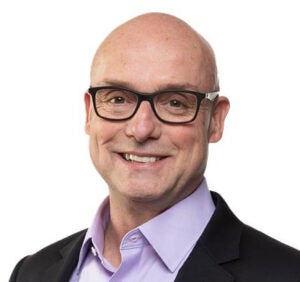
John DeVine, Oath’s newly minted CRO, faces a steep challenge in integrating Yahoo and AOL’s sales organizations.
“Priority one is cultural alignment and making sure we have clarity on who our clients are and where we’ll win in the marketplace,” DeVine told AdExchanger. “We’re going through the process now to bring the two sales teams together, which as you can imagine, is a complex process.”
Although AOL and Yahoo both have programmatic and premium content chops, the ethos of each company’s sales org is distinct. AOL ran in New York media circles, while Yahoo subscribed to Silicon Valley tenets.
AdExchanger caught up with DeVine at Dmexco in Germany.
AdExchanger: What’s the first order of business for your sales org?
JOHN DEVINE: You have two companies with 20 years of history in this industry. The companies, yes, have some differences but there’s a lot of commonality.
It’s never easy when you bring two organizations like this together, but the talent is exceptional. We had our sales conference last week. A lot happens when we’re all in the same place at the same time and we can discuss our common strategies.

What’s Oath’s sales pitch?
We want to serve advertisers across what we call “GPS,” which is growth, performance and stack.
Advertisers in growth mode are high in the funnel. They rely on us to bring 1 billion users to get that message out there through sponsorships, brand experiences and content marketing.
Performance, or when advertisers are deeper in the funnel and want to think about return on investment, is about capturing shoppers, installs. That’s where our Gemini platform is really important as well as our managed DSPs.
And lastly, stack. We will serve those advertisers who are more hands on keyboard, and who want a piece of software or a seat on our exchange.
Over the years, AOL Advertising has had a few personas, from its emphasis on code to content. Which is the priority moving forward?
In our industry, you cannot walk away from ad tech as a critical element of success and I think advertisers and publishers demand world-class ad tech. But we are leaning into the quality of our media and trusted content and data as true differentiators.
It’s a world and marketplace where, yes, there’s a movement toward programmatic. There’s also a real flight to quality. We’ve been perfectly clear about that segment of the market, which we don’t think is effectively served by the duopoly in the rush to programmatic.
Will Oath really have an “open” garden ecosystem within a year, as Tim Armstrong has stated?
We’re open in multiple dimensions. First, there’s our owned-and-operated inventory and properties AOL, HuffPost, TechCrunch, Yahoo Sports, News and Finance.
But we’re open in the way we work with publishers and how we bring distinctive partners, including Microsoft, to the table and offer an extended network of inventory to our advertisers. Along with the IAB, we’re working with third parties in verification and measurement to embed trust in our brand with Oath.
What about from a data perspective? Is Oath really a scaled alternative to Facebook and Google?
Our data proposition is very rich relative to our competitors. It’s not just an enormous quantity of data, but it’s multiple sources of data that are truly special, [including] search data, social data, web data, Flurry app data and now, of course, with Verizon, we start to mix in the mobile carrier data – deterministic as it is – and location data. We think that creates a unique cocktail. The ability to triangulate our users in context at the point when they’re most ready to receive an advertiser’s message is most distinctive.
AOL used to break out programmatic as a percentage of revenue. Can you give us an update?
I view programmatic as a way of buying, and it can be a way of buying across premium, reserved, platform or a seat on the exchange. It’s become a universal term, so the relevance of breaking out programmatic vs. non-programmatic is less of a priority for us.
What’s next?
The next horizon is around tactical execution in the markets where we’re strong, as well as growing our international strategy. Europe is important, as is Asia, Latin America. We have to be stronger in those markets. We’re crystal clear going into 2018 that winning in those markets is essential to our growth. We’ll be executing the playbook at home and then developing a strategy for growth in adjacent markets.
Interview condensed and edited.