

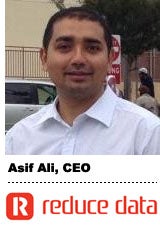
 Reduce Data uses advertiser data to optimize campaigns across DSPs and ad networks. For instance, CEO Asif Ali says when a network is buying or retargeting a user who has already clicked or converted, Reduce Data can override the network-specific optimization and deliver a different campaign or creative.
Ali says Reduce Data can similarly use its cross-network approach to cut other kinds of media waste and provide comprehensive media audits.
The company works with about 12 agencies, including Colling Media, Blitz Media, and Interactive Avenues (recently acquired by Interpublic Group). But it still has work to do in driving adoption by DSPs. Only MediaMath, DataXu and AppNexus accept its cookie today.
AdExchanger spoke with Ali recently.
AdExchanger: What problem does Reduce Data solve?
ASIF ALI: Reduce Data is essentially an analytics and real‑time optimization platform. The way we got started was this. My previous company was a mobile ad network, ZestAdz, interacting with a lot of advertisers who were primarily performance‑driven. They wanted to see conversions. They wanted to see downloads. They wanted to see subscriptions on mobile.

These advertisers would typically gather data from the ad networks at the end of the day and compare which one is doing better against the others, which one isn’t, which one they should continue to run. They needed a single tool and they didn’t have that, so they were converting these metrics offline every day.
Sometimes they couldn’t figure out why certain things were working and why certain things weren’t working. It was a lot of guesswork, a lot of manual work. Some companies could afford to use tools such as DoubleClick, and they did, but even then DoubleClick is more ad‑serving focused, less focused on data and independent optimization.
This problem existed in a wide variety of companies, including big‑name game companies such as EA Games. They were doing the same thing in online as well. What if we could connect to a DSP or an ad network, extract every single impression data at real time and help optimize on the fly? Then give a single reporting console that allows them to do an independent audit of all [media sources].
Who’s in the competitive set?
When I studied the market after leaving the company, I saw that there were tools, but these are very focused on either ad‑serving or data visualization. No one was too focused on optimization.
There are solutions in the market, but these are big players. These are players such as Adobe Marketing Cloud, and even comScore has something really good after the acquisition of AdXpose, so there are tools.
Do you use manual or machine optimization?
We are offering a real‑time analytics and an optimization platform. We want to measure data on the fly, and today our solution is really comprised of feedback. These are the recommendations, areas where your media is going to waste.
So today we are doing manual optimization. Eventually there will also be automated optimization. That’s our eventual goal. It will be in some part machine-driven. The motivation for advertisers is that this optimization is going to pinpoint things that they can actually see and fix themselves… They are very concerned about acquiring traffic at a certain price or acquiring customers at a certain price. This is a tool that will help them do that. This is a tool that will help them identify their risks at specific points.
How do you compete with a DSP that is already doing optimization?
They are doing optimization within their own network, and it’s not uncommon that companies buy from more than one DSP, and if they do there are serious issues.
Yesterday I went and looked at a product, and that product ad kept coming back to me after I bought the product — simply because there were two different networks trying to recalibrate and display the ad to me. They don’t have the data that needs to exchange across networks. The cross-channel optimization is a very important and powerful feature.
What’s your funding picture right now?
We want to raise money. We’ve raised about $500,000 through one of my peers and one of my friends, and I put in some money as well. That money is already deployed and we’ve been using it for the last three and a half months, since the inception of the company.
We’ve got three people in the U.S. right now. I’ve got about three people in Asia for engineering, simply because at this funding level, we can’t afford to have a large engineering team here in the U.S., but this requires quite a bit of an engineering effort.
I am talking to a couple of VCs and I’m looking to raise funds.
What are the milestones that you would like to accomplish in the next one to two years?
I would like to see if we can completely roll out automated optimization for online, because online is a big market, and then on to mobile.
What else?
Again, this is what I believe, that if an agency is buying from Yahoo, and buying from Facebook, I don’t think they want to be buying the same audience twice, on both Yahoo and on Facebook, right, and that is where I believe that I can add tremendous value.








