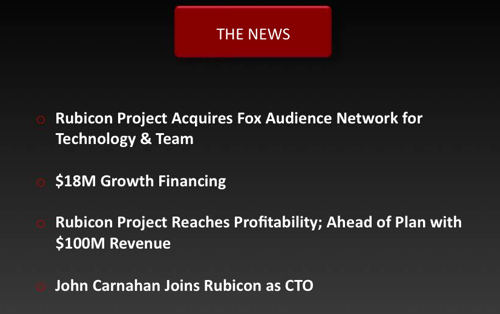
Here’s the press release (read it): Regarding the funding, “The Rubicon Project also announced an $18 million round of funding, bringing total financial investments to $60 million. The current financing round included funding from News Corporation, Clearstone Venture Partners, IDG Ventures Asia, Mayfield Fund, NBC Universal’s Peacock Equity Fund and Jarl Mohn. the Rubicon Project reached profitability in October 2010, ahead of plan and excluding any revenue from the FAN acquisition, it will generate more than $100 million in revenue in 2010.”
From the call:
Details coming, but the top line from the call thus far is that in addition to $18 million in financing and acquiring Fox Audience Network assets, CEO Frank Addante says that FAN CEO John Carnahan will join RP and the company is profitable with a $100 million run rate – pre-FAN acquisition. He said that the the FAN Acquisition accelerates Rubicon Project platform development by 18-24 months.
More notes:
- Still positioning REVV platform as the platform for publishers.
- “No other company in the world reaches more people than the Rubicon Project. 1/2 trillion of real-time bids in the past two or three months.” – Addante
The FAN integration
- The plan: Yield optimization; Enable publishers direct sales team; Down the stack and replace publisher’s ad server.
- Addante stresses 100s of million dollars invested in FAN by News Corp.
- “interesting” pre-search technology in FAN.
- Over 100 people from FAN (Was 300?); also had a FAN direct sales team – Addante says the company walked away from direct sales model and did not acquire that sales team.
- Strategic Data Corp assets is 11 years under development (now under RP umbrella).
- Positioning as an alternative to Google with “3x more scale.” Again, Addante hints about search technology.
- RP is audience targeting vs. Google’s contexual targeting according to Addante.
- Stressing “we don’t sell directly to advertisers.”
- April 2011 launch of primary ad server.
- $200 million in revenue in 2011 says Addante.
- MyAds roadmap still under development. REVV platform will handle publisher side of FAN assets/network.