

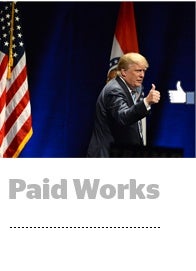
 As many have pointed out, Donald Trump won the presidency while spending a fraction of what Hillary Clinton did on ads and technology. But his campaign had a more concrete paid media strategy than some may have realized.
The Trump campaign worked with Cambridge Analytica on polling, digital media and data. The company’s head of product, Matt Oczkowski, said it relied largely on Facebook to match identities and target ads.
Search and email will remain important channels, Oczkowski said, “but places like Facebook and Google that have so much audience data and audience targeting are the future.”
And Trump wasn’t the only Republican to embrace Big Blue. The National Republican Congressional Committee, which is focused on House races, upped its Facebook advertising by 1,500%, according to digital director Tom Newhouse.
Cambridge Analytica worked with Rocket Fuel as its DMP to generate new audience lists continuously based on states and pressing issues in the news cycle or based on internal polling. Those lists were then matched and applied primarily through Facebook.

Outside of Facebook, the campaign bought from more than 30 inventory sources, including custom PMPs, direct media integrations and a host of commercial ad tech vendors.
The Trump campaign strategy was to merge paid and earned media, using the former to elevate the latter.
Bloomberg reported in late October that Trump was using blended earned and paid content with Facebook dark posts, which allowed the campaign to promote only to black audiences a 1996 sound bite of Clinton suggesting some African-American men are “super predators.”
While Cambridge Analytica operated separately from Trump’s earned media and press operation, the company’s head of digital, Molly Schweickert, said issues surfaced by Trump on social media would dictate “which audiences were targeted that week, or which received dark posts.”
The ability to mute the visibility of a Facebook post beyond the target demo also means the paid placement is less likely to spin into a damaging story in the press, which can happen when a candidate runs ad campaigns of which other parts of his or her political coalition wouldn’t approve.
One NDA-bound source with knowledge of the RNC’s media-buying strategy said people failed to appreciate how effectively campaigners on the right were leveraging Facebook. “We could make all the lists we want, different universes of people all the time so there isn’t oversaturation, and hit almost all of them with just the messages we wanted to serve them.”
Where The Money Went
Borrell Associates’ early political forecast marginally overestimated digital ad spend from candidates, parties and super PACs, but it wasn’t dramatically off. The unconfirmed final figure is expected to be just shy of $1 billion, compared to projected spending of about $1.1 billion. Television alone missed revenue forecasts by more than $1 billion.
The cycle was more likely an outlier than a sign of campaigns to come, said Kip Cassino, executive VP of research at Borrell Associates.
“You have to judge whether other candidates would be able to manipulate earned or free media the same way Trump did,” he said.
One bright spot for paid digital media was down-ballot races, Cassino said. The costs for Senate, House and state-level offices this year blew previous high marks out of the water, as super PAC funding moved down the ballot and low spending on presidential races left inventory to fill.
“While the top of the ticket was driven by earned media more so than in the past, this actually contributed to more paid digital at the state and local levels,” said Peter Pasi, a Collective VP and GOP tech operative. And whether or not the next race features the same earned media dynamics, expect outside group spending on ballot initiatives and state or local races to remain.
“The greater use of digital at the local level was driven by the increased ability to deliver against small geographic and behavioral targets,” Pasi said. “All in all it was a growth year for political digital media.”







