Here’s today’s AdExchanger.com news round-up… Want it by email? Sign up here.
The Four-Minute Mile
Details of the new Disney+ ad-supported tier are leaking as Disney lays the groundwork for its upfronts sales pitch.
For one thing, Disney+ will carry about four minutes of commercials per hour, with zero ads for preschooler-aged accounts, The Wall Street Journal reports.
HBO Max also benchmarked its new ad-supported tier at four minutes per hour; Peacock sits at about five minutes, Hulu more like eight. Linear commercials soak more than 18 minutes per hour.
Disney+ ads are expensive, as one might expect. But the company won’t let advertisers purchase ads for specific programs, which they can do on linear TV. The new Disney ads will have the vibe of a lucky dip (“Ooh, we got a Marvel and some Star Wars!”).
Disney will also prohibit alcohol brands, political ads and rival streaming services or entertainment studios, Variety reports. No poaching on Mickey’s preserves.
Although, the conquesting policy isn’t new. YouTube TV can’t advertise on Hulu and hasn’t been able to for years. Netflix already can’t air ads on Disney-owned networks. TV nets wouldn’t take Amazon Prime trailers during NFL games, so Amazon went over their heads and became an NFL sponsor (and now has exclusive distribution rights for Thursday Night Football).

Share Tactics
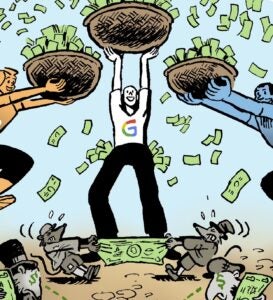
Google is (unsurprisingly) calling foul on Canada’s new Online News Act, the Press Gazette reports.
Similar to the Australian News Media Bargaining Code enacted last year, the proposed law compels Google and Facebook to sign cash-for-content agreements with news publishers.

Google’s and Facebook’s threats to stop doing business in Australia if that legislation passed never materialized. Now, both companies pony up at least $140 million per year to Australian publishers.
Google’s Richard Gingras describes the proposed Canadian law as “the kind of regulation that breaks the internet.” Google Canada’s Sabrina Geremia says in a blog post that the act would impose a “link tax” and Google would be forced to share revenue with “outlets that do not adhere to any journalistic standards.”
Google also claims the Canadian Radio-Television and Telecommunications Commission would be out of its depth in determining which publishers are eligible for revenue sharing.
But, using the Australian law as a baseline, industry watchers are skeptical that the Canadian law would have wide-ranging negative effects on Google Search or Canada’s news publishers. Regarding the Australian law, the International News Media Association’s Robert Whitehead said “there’s clearly no link tax and there has been no threat to Google’s search business whatsoever.”
A Little Birdy Told Me
The Elon Musk Twitter takeover is on skids (again). This time, Musk is purportedly rethinking the deal due to the number of illegitimate accounts on the platform.
According to one tweet Musk sent on Tuesday: “My offer was based on Twitter’s SEC filings being accurate. Yesterday, Twitter’s CEO publicly refused to show proof of <5%. This deal cannot move forward until he does.”
Another tweet was simply the poop emoji in reply to a long, nuanced thread by Twitter CEO Parag Agrawal detailing the complexities of spam account and bot management.
Musk prefers more scientific methodologies, like tweet polls and back-of-the-napkin math fudged together by admirers.
Musk’s contract to buy Twitter has a billion-dollar penalty if he reneges, and he contractually agreed to waive the business due diligence. Not having any idea what he was buying is not a compelling contractual out.
Per another of Musk’s tweets to Agrawal: “So how do advertisers know what they’re getting for their money? This is fundamental to the financial health of Twitter.”
Not understanding how advertising or Twitter works is an unfortunate precondition for someone who’s buying Twitter.
But Wait, There’s More!
Candle Media, a Blackstone-backed media rollup firm, acquired the video content production company ATTN: for $150 million. [Axios]
TheoremOne merged with Sorrell’s S4Capital, will lead its technology services practice. [release]
What’s next for subscriptions and subscription strategy in the publishing biz. [Media Voices]
Instacart Ads expands to Canada. [release]
Programmatic tech company Tappx acquires mobile game developer From The Bench’s brand. [release]
You’re Hired!
ActionIQ appoints Panayiotis Vitakis as chief customer officer. [release]
The CDP BlueConic names Leonardo Carbonara as VP of product. [release]