
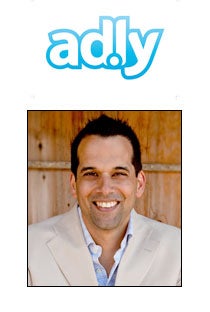
 Arnie Gullov-Singh is CEO of Ad.ly, an in-stream online advertising network.
AdExchanger.com: You have an extensive background leading to your CEO role at Ad.ly. But, what key learnings do you think you’re bringing from your experience at Fox Audience Network, in particular?
AGS: I learned a ton about what it takes to build a high performing organization and how the big corporations in our industry make major strategic and financial decisions. I was also given a lot of freedom by Adam to drive the strategy at FAN and provide leadership to the organization, which is very unusual for a big company and certainly helped me grow into a more effective leader.
What problem is Ad.ly solving in your estimation?
Ad.ly is 100% focused on monetizing the stream. We’re doing this today by connecting top tier content creators on Twitter with top tier brands to enable micro-endorsements. We’re helping content creators monetize their audiences and we’re helping marketers get their brand messages into the stream in a controlled, well-lit environment. Our platform is a huge timesaver for both parties as it brings economies of scale to what has traditionally been a series of point-to-point, offline transactions.
How does Ad.ly differentiate? Is being first-to-market critical?

I think its more critical being simplest-to-market. Ad.ly launched with a solution that is easy for marketers, content creators and users to understand. Its paid off, enabling us to scale quickly and provide marketers with targeted reach into over 45 million unique monthly users on Twitter, through a network of 60,000 of the most influential content creators. We’re making it easy to spend money on Twitter and I think that’s what’s resonating most in the advertising community right now.
Twitter COO Dick Costolo said in the post announcing their terms of service change, “We will not allow any third party to inject paid tweets into a timeline on any service that leverages the Twitter API”. In your Ad.ly blog post, you say that the company still operates under Twitter’s TOS. Can you provide a use case on what Ad.ly does that’s different than “injecting” paid tweets leveraging the Twitter API?
Twitter’s TOS change is designed to eliminate the low quality, deceptive practices of 3rd parties who are using Twitter’s API to post ads into a user’s stream without the user’s consent. This always happens on successful platforms – think black hat SEO on Google, friend request spam on MySpace, aggressive continuity products on Facebook apps. In each case the platform owner has to take steps to clean up their ecosystem for the good of their users and in most cases it becomes an ongoing battle.
By contrast, Ad.ly is all about quality, transparency and disclosure. We work with top brands like Sony, NBC & Microsoft to bring high quality offers to our publishers. Publishers have full control over whether to accept or deny individual ads from our advertisers. If they accept an ad, they use Ad.ly as the application to schedule sending their tweet to their followers at the time and date requested by the advertiser, much like they use other apps to send out organic tweets. By using our application, publishers enable advertisers to track that their ads are being delivered as contracted and it also ensures that every paid tweet is sent out with the proper disclosure.
How does Ad.ly add value to Twitter?
We’re helping Twitter’s most influential users monetize their audiences, much like how Google helped bloggers become businesses with AdSense a few years ago. This is important because it keeps Twitter’s users invested in staying on Twitter. Through doing this we’re also helping marketers understand how to advertise effectively on Twitter, which is obviously good for the platform and the stream as a whole.
Regarding expansion, can the Ad.ly business model be brought to other social media networks and applications such as Facebook? Seems risky to be leaning on one platform – Twitter.
Twitter is a great platform for sharing content and has considerable scale so it made sense to start there as a way to enter the market quickly. Now that we have raised additional funds and are growing fast it makes sense for us to extend our reach into the broader stream ecosystem.
Given your experience at the Fox Audience Network, what are your thoughts on the display (or data-driven) advertising ecosystem? Anything surprise you?
I think the biggest surprise was around the relative worth of inventory and data. When we started the group that became FAN we thought that having access to inventory was a commodity and that having access to data was the competitive advantage. Within the past two years we’ve seen data become more of a commodity and access to inventory become more of the competitive advantage.
Given the usage of “.ly” in the Ad.ly domain, what if Libya suddenly decided to take back all of the domain names associated with its top level domain? Is there a disaster plan?
We own adly.com, so we can easily switch over if we need to.
Will Ad.ly need to tap the venture capital world again? Or can you grow the business sufficiently with what you have?
With the $5M we just raised I think we’re in good shape right now. Our revenue is growing much faster than expected and we’ve got a terrific team of engineers and salespeople operating very efficiently, which will help us keep our expenses under control as we scale.
A year from now, what milestones would you like to have seen Ad.ly accomplish?
We have a lot of early data that shows in-stream advertising is generating great ROI for marketers, which makes it an attractive proposition for search marketers. By this time next year I expect us to have proven that out on a much larger scale.
Follow Arnie Gullov-Singh (@arniesingh), Ad.ly (@adlyads) and AdExchanger.com (@adexchanger) on Twitter.








