
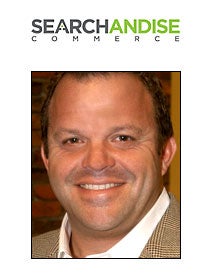
 John Federman is president and CEO of Searchandise Commerce, an online media network for product manufacturers and their retail channel partners.
How did Searchandise Commerce come together?
Searchandise Commerce was founded in July 2008 by an executive team with extensive advertising, retail, search and high-tech experience. Our business model is based on the proven technique of in-store merchandising, where manufacturers pay for placement, and combines it with paid search tactics. We are the first online media network allowing product manufacturers to boost visibility through cost-per-click bids, and enabling retailers to generate an incremental revenue stream via those clicks.
What problem is Searchandise Commerce solving?
Research shows more consumers are turning to the web to research products and increasingly, they are spending a significant portion of their search on retail sites. This creates a challenge for the manufacturer to break through and be seen, and it creates an opportunity for the retailer to monetize on-site shelf space. Until Searchandise Commerce, retailers have not had a simple solution to monetize Web real estate without moving into advertising. At the same time, manufacturers have never been able to positively affect their position in site-side search listings.

Just as retailers charge for end-caps, kiosks and displays in the brick-and-mortar world, they can apply cost-per-click (CPC) bids in the online world. A CPC approach provides tremendous incentive for manufacturers looking to increase their position “inside” the online store. This demand and network model has the potential to deliver additional benefits to the retailer, beyond significant new revenue. As with search advertising revenue sharing models, when a shopper clicks on a sponsored linked on a retailer’s site, the manufacturer pays the associated cost to the network, which in turn pays the predetermined share to the retailer. This means that, unlike virtually every other investment designed to increase or create revenue, retailers can adopt a site search monetization approach without any upfront costs.
Who is your target market(s)? Any competitors in your space?
Product manufacturers, brand marketers and advertisers tasked with moving product through online retail channels, and their search or ad agencies are our target market, while our partners are comprised of mass merchant retailers and comparison shopping engines. We are currently working some of the world’s biggest brands including many of the Top 50 Internet Retailers.
While Searchandise Commerce has no direct competitors, there are a number of solutions vying for the same budgets include paid search, on-site advertising including some of the virtual boutiques and brand showcases that you see on retail sites, and other enhancements like recommendations and personalization technologies.
How has the consumer evolved in researching products available through ecommerce sites?
Over the past few years there has been a dramatic shift in the way consumers are researching and purchasing products, moving from primarily in-store to online. Quite frankly, consumers are getting smarter. Long gone are the days where consumers just walk into a store and make a purchase. There is more information available to consumers and more ways to get it – whether it’s online or on a mobile device.
Consumers do the research before purchasing and often times after purchasing to make sure they got the best product for their specific needs. In fact, Credit Suisse reports 87% of consumers conduct product research online before purchasing in person. Additional research from Forrester Research also supports the significance of online – in 2009 the Web influenced $937 billion in total U.S. commerce sales.
Retail sites have responded to the shift in behavior by improving what they offer consumers so there’s no wonder more consumers start at the retail sites than anywhere else. On a retail site consumers can easily compare price, functionality and consumer reviews thanks to robust on-site search solutions.
What’s a common mistake online retailers are making today?
Retailers don’t often realize that their sites can work harder for them. Sure, everyone knows to select keywords for SEO purposes and collect data for customer analytics, but there are other ways to monetize your site without any heavy lifting. The 2010 holiday season will be here faster than we think and many retailers add extra enhancements and features – often costing money. Wouldn’t it be nice to have something like CPC bidding already in place as a supplemental revenue stream that would pay for the these features?
The bottom line is retailers monetize every inch of shelf space in a physical store – they should do the same on the online store.
What’s your view on display advertising- is there a Searchandise Commerce product that uses display down the road given display’s demand-generation potential as it pushes down to the demand fulfillment of search?
There are many other display tactics already used by retailers, including display advertising. We remain committed to a pay-for-performance model and have no plans to enter the display advertising marketplace.
What pricing models do you offer your clients?
We set our CPC bids for manufacturers based on the lowest price possible to move their product. Examples range from $0.50 for a razor to $1.25 for a digital camera and so on. Our revenue share also varies per retailer.
How will you scale Searchandise Commerce’s business?
We proved our concept in the consumer electronic category having worked with, and continue to work with, many of the world’s leading manufacturers. We have now successfully moved into other categories such as consumer packed goods. If a product category has competing brands – housewares, appliances, sporting equipment, tools, shoes, etc., we expect we will be working with them.
Over the past year we’ve increased our network, known as CommerceNet, from approximately 131 million visitors per month to 290 million visitors per month and we’ll continue to focus on the top internet retailers in order to grow the network.
How many people is your company today? Also, please discuss your recent funding and how you’re going to use it.
Searchandise Commerce has more than 20 employees and we’re growing quickly based on our successes and market demand. We just closed a $7 million Series 2 funding round in April 2010. The round was led by new investor Madrona Venture Group with participation from existing investors Cloquet Capital Partners LLC, DFJ Gotham Partners, Draper Associates, Inflection Point Ventures, Milestone Venture Partners and Wheatley Partners. The new financing will be used primarily to expand our sales/marketing and operations teams. We previously raised $7.5 million in venture capital in July 2008.
A year from now, what milestones would you like Searchandise Commerce to have accomplished that it hasn’t already?
We’ve spent the past two years proving our concept works and building our network and customer base, so the next year is focused around growth. The retail, search and advertising industries are evolving and we believe our solution is at the forefront of these changes.
Follow Searchandise (@searchandise) and AdExchanger.com (@adexchanger) on Twitter.







