
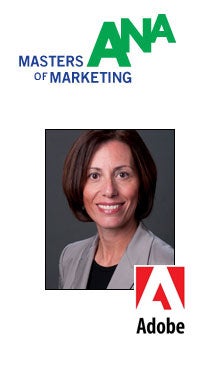
 Among several presentations from last week’s Association of National Advertisers that were particularly relevant to the data-driven, digital ad ecosystem, Adobe marketing SVP Ann Lewnes’ (see bio) presentation stood out as she said simply, “Marketing is the new finance” and described how important data is to driving her company’s marketing.
Of course, there are selfish reasons for Lewnes to make such a statement considering her company’s ownership of Omniture, which provides variety of data-driven products and services. The Omniture unit acquired data management platform Demdex earlier this year as it continues to build an end-to-end, marketing technology stack.
Adobe wants marketers to come aboard – the ANA event was the perfect captive audience.
Lewnes elaborated on the financial angle to marketing:
“Marketing is the new finance.
I hope you’re not insulted by this. This is not a bad thing. Data is the digital revolution’s gift to marketing. Intuition is always going to be important to us as marketers. But in today’s world and economy, there is simply no room for guesswork.
We need to be able to quantitatively demonstrate our impact. We can do that now. So let me tell you a little bit about how we do an update.
There are three basic phases in which we are doing our measurement. In the pre‑launch of the campaign we use econometric modeling. (…)
How this works is you basically have to supply the model with three years of historical data. So, my advice to you is keep all of your records. You pour this data into a model. I kid you not. You are able to forecast how much marketing you will need in terms of your budget to reach a given revenue goal. We have done this now for several quarters and we are within five percentage points of margin of error.
In addition to that, we are able to optimize the marketing mix. Again, looking at the historical data, we can see what makes was optimal for which products and for which countries. So you can tell how much you should spend on social, how much you should spend on display, how much on PR, [and so on.]
(…) We used to follow strategy. Now marketing is helping to determine strategy.”

So the message is about empowering the marketer, which is any marketing software company’s pitch, but with a twist. The marketing strategy normally is informed by the company’s overall corporate strategy set by the CEO, board and others charged with those responsibilities. Here, Adobe is suggesting that the marketer gets even more involved in setting a company’s agenda. Given the data and insights that are possible, why wouldn’t you use the marketer’s ability to test and discover new strategy?
Lewnes launched into a gentle pitch of the company’s products but also provided a how-to for marketers considering data-driven marketing products from any company – not just Adobe.
Addressing the ANA brand marketer audience, she got down to the basics:
“The trick is to know your goals. If you don’t know your goals, and you are measuring all of this, then it’s like a sea of data and you don’t know what to measure. Just like every other campaign, you need to have four or five indicators at the beginning of the campaign so you know what you are looking for.
We actually have a dashboarding capability that we have created. (…) People want to have the data at their fingertips. But again, the important thing is to know what you are looking for, otherwise you’re not going to be able to solve the problem.
At the end of the campaign, we are able to assess how we did overall and look at things such as marketing’s contribution to revenue, marketing ROI and campaign efficiency. We are looking at every single variable and doing this throughout the process to see how it performed. We even judge things like brand value and how we are performing against that.
We used to, as marketers, only be able to tell how we were doing at the end. Now we can use our data and analytics all the way from the beginning of the process, through the process to continuously iterate and serve up content that our customers want and, in the end, assess how we are doing. Then we can apply all of those learning’s to the next campaign.
I still get asked every single day by my boss, the CEO, as well as our CFO to prove our ROI. But now, I have a good answer.
Digital lessons tell richer, more compelling stories and it lets us connect much more deeply to our customers. Social lets us speak directly to our customers and it lets them tell us what they want. We can please our customers, because we can communicate two‑way with them.
Third, data and analytics let us measure everything and prove everything. In the end, I don’t think we (marketers) have ever been more critical to the business. That’s why I think this is the best time to be marketing.”
Lewnes paints a rosy picture for sure, but the ability to understand ad spend will only get better technological innovation spurs insights unlocked from marketing’s – and the entire enterprise’s – vast datasets.
In theory, assuming your big brand company has the marketing tools, team and budget to address online and off, the time to be in marketing only improves in the future.
By John Ebbert







