

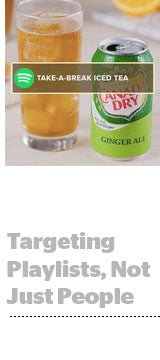
Many advertisers want reach, but when Canada Dry executed a campaign with Spotify and Adobe, it optimized against a softer metric: mindset.
“We don’t think of consumers as just 18-49-year-olds or young millennials,” said Brit Sundberg, programmatic media and data strategy manager for Dr Pepper Snapple Group, which owns Canada Dry. “We think of our consumers from the perspective of when, why and how they’re consuming our products.”
Canada Dry banks on the belief that consumers lead busy lives and everyone needs a moment to themselves to kick back.
Canada Dry determined that the optimal time to make an impact was mid- to late afternoon, when someone might take a break from work with some streaming audio.
And Spotify – with its variety of “chill” playlists – matched those contextual requirements to a T.
For a summer campaign that ran between May and July, Canada Dry aligned to “listening occasions” on Spotify.
“We really backed away from looking at pure consumption targets and audience to go more after mindset, not going too narrow with our targeting,” Sundberg said. “We relied on Spotify for that identification, as well as some loose age qualifiers.”

Spotify, which has an authenticated base of 140 million monthly active users, pitches advertisers on its ability to go as narrow or as broad as they’d like with targeting.
“The idea of building a user interest graph around moments is one thing that’s really differentiated us in market,” said Brian Benedik, VP and global head of ad sales for Spotify. “When a brand has a very defined marketing objective around a mood or moment like Canada Dry did, that’s when it really comes to life.”
Canada Dry used Adobe Advertising Cloud’s demand side platform to outline its campaign parameters and to place its buy. (Although advertisers can still access Spotify inventory on a direct, I/O basis, Benedik said programmatic activations are growing faster than its direct order business.)
 The brand purchased programmatic voiceover audio spots, in-app display, video and sponsored sessions.
Although Canada Dry used Facebook’s Atlas to measure frequency and pacing across devices, it viewed this particular campaign more as a proof of concept.
Buying converged audio and video programmatically is still in its early days, and Canada Dry wanted to see how an automated buy leveraging contextual targets – not just audience – would play out.
“As a brand, we feel pretty strongly about streaming audio and have done a fair amount of it across various different partners as listening habits change, but for this campaign we wanted to ensure the table stakes,” Sundberg said. “Can we actually execute this and will it scale in a healthy way?”
Canada Dry used Spotify’s integration with verifier Moat to gauge harder media metrics. For instance, it determined its placements were 95% in view across the board, while audibility and viewability on completion was about 87.5% (compared to the average benchmark of about 42.4%).
Sundberg liked that Spotify’s streaming environment is tailored for viewability, while incentivizing advertisers to produce quality creative.
It also does a better job curating playlists and music suggestions (which fosters intent as opposed to passive listening) than other streaming audio competitors, he added.
From Adobe’s perspective, Spotify adds a lot of incremental audience – achieving as high as 99% in deduplicated reach – for certain advertisers, according to Sahil Gupta, director of advertising partnerships for Adobe Advertising Cloud.
“Based on the success we saw in this campaign early on, we started tacking on PMP inventory for other campaigns as well,” Sundberg said. “To a degree, other brands in our portfolio, such as Schweppes, have a similar dynamic of ‘relaxing harder.’”








