

Can hyper-localized marketing really drive interaction and sales?
For made-to-measure men’s suit brand Indochino and healthy foods manufacturer Daiya Foods, the answer seems to be yes.
Indochino gained fame as an online suit service, wherein consumers would send their measurements to Indochino via a web portal and have a custom suit made. But in recent years, Indochino has expanded its brick-and-mortar presence, doubling its storefronts in 2017 from 10 to 20 – with plans to add 18 more this year.
And local marketing has been a boon to this strategy.
“With each market we enter, the goal is to introduce the Indochino brand to the city and also to drive showroom appointments,” said Lisa Craveiro, director of customer acquisition for Indochino.
But Indochino’s brand awareness isn’t always high when it enters a new US market.
In the past, Indochino would spray and pray, sending paid traffic to generic landing pages that illustrated the new Indochino showroom experience.
While this approach required less marketing resources, it didn’t speak to the needs of individual markets.
So Indochino started using the platform Unbounce to create geotargeted landing pages for desktop and mobile, which integrated with its attribution and analytics tools.
“It really allows us to target specific audiences with localized messaging, so they’re immediately informed of their nearby showroom when they visit the site or landing page,” Craveiro said.

For instance, if a visitor from SoHo visited the online storefront, Indochino found it got higher conversions – showroom appointments, in this case – from messages saying “Visit our SoHo showroom” vs. “Visit our New York showroom.”
 All told, Indochino increased showroom bookings by 77% since creating localized messaging.
Daiya Foods, a popular maker of dairy-, gluten- and soy-free foods, also took a hyperlocal approach to branding.
In addition to reaching more prospective shoppers, it wanted to drive purchase intent for its cheese-style spreads and yogurt alternatives among two types of consumers: those most likely to engage with the Daiya brand and those who often shopped at competing stores like Whole Foods and Target.
Daiya used AdTheorent’s “geo-contextual targeting” to gauge users’ location patterns over a period of time, which helped make segmentation more precise.
It tapped third-party segments, like women ages 25–41 who shop at natural food stores and who are interested in healthy living, as well as location-based segments (like consumers who shop at a regional Whole Foods three times a month), said Nicola Shaw, director of marketing for Daiya Foods.
Then, AdTheorent ran predictive targeting on top of Daiya’s campaign parameters to find like-minded shoppers who were more likely to take an action. (The company partners with a credit card issuer to tie in-store sales back to ad exposure in less than 72 hours).
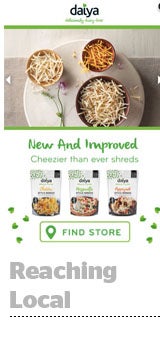
Consumers spent an average of 8.6 seconds engaging with Daiya’s rich media creative, including store locators and product carousels that change based on product availability and seasonality.
The brand also had a strong “secondary” engagement rate of 6.9%, with most users visiting its product site for more information or viewing the product gallery after engaging with a rich media banner initially.
“We liked this strategy for driving in-store visits and purchases in particular, because it reaches consumers most likely to convert as they have already proven to be frequent natural food shoppers,” Shaw said.









