

 Like many big companies, Kimberly-Clark ramped up its investment in data-driven display media last year.
The personal care giant, whose brands include Kleenex, Kotex, Cottonelle, and Huggies, started looking into a display “desk” a couple years back, and set one up last year in partnership with its media agency, WPP Group’s Mindshare.
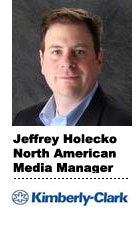
Jeff Holecko, who oversees North American media operations as well as agency planning and buying relationships for all KC brands, is pretty clear about the value programmatic buying has delivered. “2012 was proof positive of the benefits in both driving efficiency and quality. We had very specific qualitative and quantitative goals. It’s blown through all of them,” he says.
One key to success has been tight integration of programmatic display with the media organization. The team sits on the same floor with KC’s comms planners, media planners, and buyers for all other media. Enhancing this synthesis — especially with regard to data sharing — is a big focus for 2013, says Holecko.
“There is an opportunity in better linking the data, media planning and buying teams. I think it would be helpful for the data professionals to better understand on and offline media professionals and vice versa,” he says.
Holecko spoke with AdExchanger about KC’s early display ad experiments, ad tech partner strategy, and optimizing for the upper funnel.
What are the big changes you’ve seen in the media landscape, especially display media? How have things changed since you started?
There are quite a few more options since I started. It’s a more dynamic environment. It also can be a bit of a treacherous environment. There is an exhaustive amount of inventory. There are more partners to work with and more levers to pull. It’s exhilarating actually.
It’s also an environment where marketers need to have both hands on the wheel and get involved. We need to use the available tools to mine data in order to reach the right people and the right environment and to evolve with the marketplace.

When I started, you had a number of options but you didn’t have the incredible number of ways to reach consumers. There are just more options. There’s more data available, including our own first-party data. I think we’ve done an incredible job here to set up a system where we are able to plan and reach a higher quality consumer, test messages in real-time or near real-time and optimize in real time or near real time. Ultimately, we have better control over how we optimize our communications.
The days of just sending out a message via an impression, and then waiting weeks to see how that message resonates, are over.
In your early experience with real-time media optimization, what were the best knowledge sources?
We started speaking about real time optimization and building “desks” a couple years back. That’s where the market was moving. We spoke to and learned from data, agency, and media partners. Our industry associations were also very helpful educating us on real-time optimization.
So it has met your expectations?
Yes, it has far exceeded our expectations. When we set up our expectations we did a full-on evaluation of about eight or ten different approaches and laid out our expectations. 2012 was proof positive of the benefits in both driving efficiency and quality. We had very specific qualitative and quantitative goals. It’s blown through all of them.
Can you say broadly what type of goals you had?
Our goals ranged from everything from delivering on efficiency to Commercial Program effectiveness goals. One of the first goals was to simply establish the structure to mine our own data, mold it with outside data, and optimize in real time. We’re now set up for addressing upper or lower funnel goals depending on Commercial Program objectives.
A question on partners. You’re working closely with Mindshare and I presume a demand side platform on this initiative. I’m curious how you decided on that little cocktail. Many clients are being pitched by the big trading desks that are run by the agency holding companies. How did you make that decision to keep this activity local to your media agency?
When we went to the market we started by looking at the model we wanted that would address our internal corporate goals and our short-term and long-term commercial program goals. We created it in partnership with our CRM, procurement, media, and digital leads.
We identified our overall objectives. We did a full proposal process with around eight different vendors. In a very structured and rigid way, we netted out with the final partnership because it met our collective requirements. Additionally, we wanted a model that could potentially help our global KC partners.
Mindshare oversees our planning and buying. They’re also a major partner in our research efforts. They came to the table as the best solution that easily plugs in with our internal needs and system.
How integrated is your trading desk with the rest of your media planning?
The desk buyers are on the same floor as the coms planners, media planners, and media buyers for all other media. It’s not like we have someone sitting in another office and we have to bring in another team to integrate for every Commercial Program. It’s naturally integrated. The desk team can work as easily with the multi-cultural team as they can the search or planning team. They are included in the Commercial Program objectives and goal discussions.
What do you think 2013 can deliver for the trading desk and display media for Kimberly-Clark?
The opportunities are vast. In 2013, we’re going to move further into optimizing on engagement goals. We’re going to drive more optimization on mid-funnel and higher-funnel goals.
We’re also looking to expand opportunities in video and social.
Finally, we’re looking to expand the landscape of the desk and help our global KC partners experience the success we’ve seen in North America.
Does the term “big data” mean anything to you? On an operational marketing level, how does that play out?
Everyone talks about big data, but everyone has a different definition. I think the biggest data is simple and actionable data. Data is key to everything we do in media. We’ve always used data to plan and buy on and offline media.
We simply need data to be more efficient and more effective at reaching the right people at the right time. The trick is identifying and delivering actionable data to get our messages to the right people in order to execute and optimize against our goals.
There is an opportunity in better linking the data, media planning and buying teams. I think it would be helpful for the data professionals to better understand on and offline media professionals and vice versa. One of the operational opportunities is getting the most actionable data offline as well as online planners and buyers at the right time in the planning and buying processes.







