

 Andy Kauffman, Marriott’s VP of digital marketing, loves running tests.
“We’re very comfortable failing as long as we learn from that and iterate going forward,” said Kauffman, who oversees product and digital brand strategy for Marriott.com. “It may be an overused term, but we really do embrace a test-and-learn approach.”
There are dozens of multivariate tests running on Marriott’s site at any given time across creative and media types.
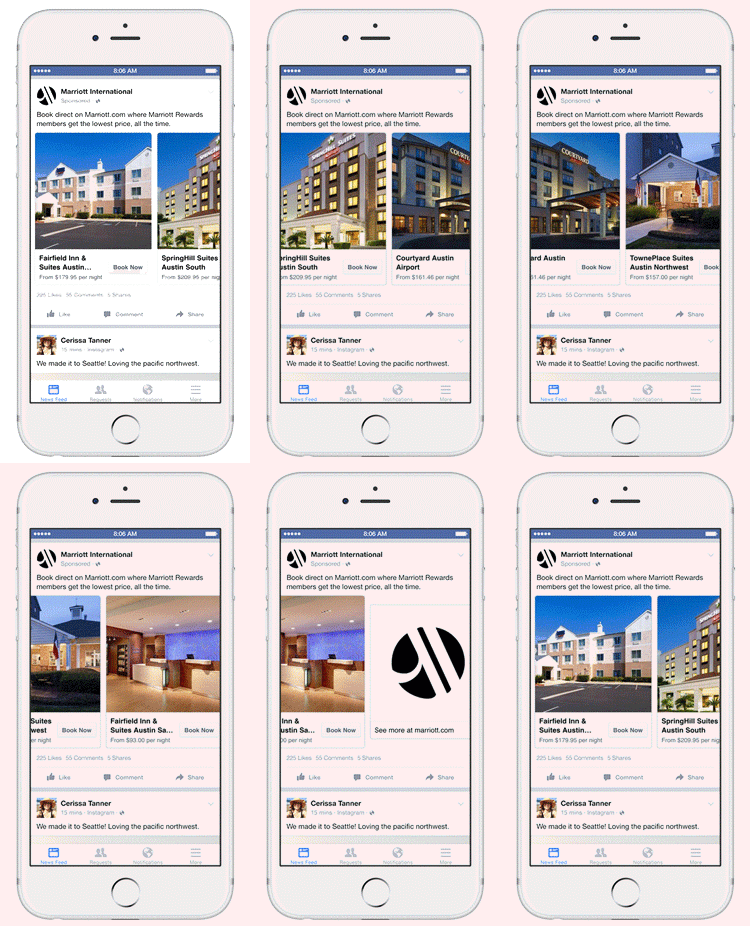
Marriott was also the first hospitality brand to start testing Facebook’s Dynamic Product Ads last year to retarget users on Facebook based on previously demonstrated intent and browsing behavior across devices.
Facebook recently expanded its Dynamic Ads offering to Instagram and rolled out a version of the product specifically geared toward the travel vertical to help travel brands target users who have expressed interest in traveling to particular locations during particular dates. Marriott International and Trivago are launch partners.
“Our philosophy is data over opinion,” Kauffman said. “That’s one of the reasons we like to get in early with partners like Facebook, to work with them to create and fine-tune the right formula.”
Marriott International has 19 hotel brands under its umbrella, including Renaissance, JW Marriott, The Ritz-Carlton, Courtyard, Residence Inn and Moxy, and operates nearly 4,500 hotels worldwide across 87 countries.
Kauffman spoke with AdExchanger.

AdExchanger: What’s in Marriott’s tech stack?
ANDY KAUFFMAN: From the beginning it was important to us to build what we call a Marriott-centric stack, rather than an agency-centric stack or a vendor-centric stack. If we want to engage our customers properly, it’s critical for us to have common decisioning and orchestration across channels, whether that’s the site, paid media, email or search.
Technologywise, we clearly have a DMP and a DSP in there. We’ve consolidated so that we have one DSP and one dynamic creative provider. It’s hard to do messaging sequencing if you have too many providers. Our stack is a combination of third-party providers and some proprietary stuff. But it all starts with data and the insights we glean from it to drive actions.
We also work with a combination of agencies, including our global media agency MEC, and five different search agencies around the world that work locally while we take care of strategy in-house.
How do you decide what to do yourself and what to outsource to a partner?
The things that create strategic value are the things you want to own – like insights and intelligence around how to use digital to give our guests a better experience on our properties. But it’s not necessary to own something like, say, tag management. There are already lots of great tag solutions out there, and there’s no point in creating a proprietary one.
How does Marriott approach programmatic?
Programmatic is not simply a media-buying strategy. We think about it as the intersection of paid, owned and earned. Our formula is to combine data, insights and compelling content to deliver a personalized experience across devices. You need a combination of all three or the experience falls short. A lot of marketers think about these things separately.
 How do you put this into practice?
We’d been doing a combination of retargeting and dynamic prospecting for years by looking at activity on our site and other sites, but those are generally device-specific behaviors driven by pixels. But then we sat down with Facebook to talk about reaching people with relevant creative across device at scale.
We became an early adopter of Facebook’s Dynamic Product Ads so that any behavior you take on Marriott.com allows us to find you in the Facebook ecosystem. We also worked with Facebook to create Dynamic Ads specifically for travel beyond booking. If someone has just booked, for example, but they’re not a Marriott Rewards member, we can encourage them to join. If they’re a Rewards member, but they don’t have our app, we can encourage them to download it. And we can target these messages across devices.
What kind of results have you seen?
It’s still early, but we’ve seen very high ROI. It rivals paid search.
How do you use data to inform your messaging?
First there’s what I call transactional data – things like photos and room pricing – which is always changing and also obviously a foundational part of getting someone to stay in one of our rooms.
A step beyond that is engaging people across their journey by presenting the benefits of things like our rewards program and why they should download our app experience. But the reason why you do any one of these things is going to be very different depending on the purpose of your trip.
We’re also trying to engage people between trips beyond the transaction, which is where lifestyle content comes in.
Content marketing probably isn’t going to immediately result in a booking, so what kind of KPIs are you looking for?
We’ve shifted away from what we call micro-KPIs to looking at the overall journey, which ultimately results in lifetime value. If you look at a view or a click, that’s a micro event, but if you look at the customer journey, those views and clicks lead to engagement that might not happen until a month or even two months later. But it does change behavior.
What are some of your remaining pain points?
Customer expectations have risen and in many cases, among millennials in particular, personalization has become expected. We’re a global company, so it’s quite challenging to scale our programs across the world, especially when it comes to cross-border data.
The EU clearly has different privacy rules, and the way in which you engage someone in the US is going to be different from how you might engage someone in Germany. But beyond legislation and compliance, we also need to think about customer tolerance in different locales and cultures.









