

Marketing, once largely a creative occupation, now requires understanding of data, tech and business. And many CMOs don’t have the necessary skills.
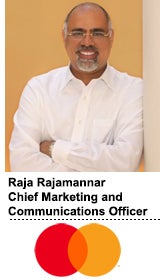
“Clearly, marketing folk are not able to justify their existence,” said Mastercard CMO Raja Rajamannar.
He added: “There is such a significant component of technology within marketing that without understanding how to leverage it, you will not be able to do your job.”
As marketing becomes a more technical discipline, big advertisers like Coca-Cola have done away with the CMO role altogether in favor of titles like chief growth officer or chief business officer.
But “general managers,” as Rajamannar calls them, who can understand how marketing, technology and business intersect are hard to come by.
“It’s a journey,” Rajamannar said. “You can never say that the journey is over because the field is evolving so rapidly that you need to constantly update your skills.”
He spoke with AdExchanger.

AdExchanger: Why is the evolution of marketing causing an existential crisis?
RAJA RAJAMANNAR: The accountability of marketing to drive business results is currently unprecedented. You need to understand the business and the financials and connect the dots with marketing.
People who have this experience are not easy to come by. If they’re available, they don’t necessarily want to be in marketing. They want to be in Silicon Valley or start their own companies. The biggest thing that keeps me awake at night is talent.
How do you find the talent you need?
We constantly retrain internal talent on various aspects of digital marketing. We send people to universities like Yale, Harvard Business School and Singapore Management University to get them up to speed on behavioral economics and consumer marketing. We’re asking some of the professors to shadow me to see what the life of the CMO is like today. We’re also doing a rotational program, where people from outside of marketing are rotating in and people from marketing are rotating out to other functions.
We’re being very thoughtful about finding people with the right cultural fit at the middle and senior levels. At the junior levels, we’re partnering with the Association of National Advertisers to hire interns every year and give them meaty, strategic projects. These kids are so smart that you need to leverage them way beyond current intern programs. And they deliver brilliantly. Last year we were able to offer every one of them a job.
Are you looking to bring more talent in house or do you prefer to rely on agencies for that expertise?
We don’t want to take things in house for the sake of in house, or go to consulting firms because it’s fashionable. We cherish a partnership with our agencies for 20-plus years. I’m very cautious to walk away from that.
We have a global leadership meeting every quarter and I make sure all the agency folks are there. I meet with the CEO of IPG and we have open conversations [about] what’s working and what’s not. That gives us opportunity to improve and to keep consolidating our relationship.
You recently removed the word “Mastercard” from your logo. How do you measure the impact of a branding initiative like that, as marketing results become more accountable?
We try to measure the impact on the brand, the business and competitive advantage.
When a consumer checks out from an online store, the networks are listed next to the credit card number [field]. Each brand gets the same amount of fairly small space. If I take away the name “Mastercard,” I’m able to expand the size of the two circles [in our logo] to occupy the whole space.
Within the same real estate, my presence has gone up by almost 12%. That is a competitive advantage. We join a select bank of iconic brands, like Starbucks, Apple and Nike, where even without the name, we are there. We are hardly six or seven weeks into the launch, so it’s premature, but it’s being well received.
Mastercard is also focusing a lot on voice. How do you measure the impact?
On smart speakers or wearables, there’s no physical real estate to put your brand. The initial solution for voice is sound and music.
Mastercard is across all categories. It’s availability of money. Therefore, the opportunity to be ubiquitous is a lot bigger than almost any other category. But to be present in a meaningful way, you need to have a strategy. At what point in the consumer journey are you going to be there? When you have an opportunity to be there, how do you manifest yourself?
How do you see online banking manifesting in a voice-driven world?
The growth of commerce in a non-visual environment is humongous. It’s exponential.
Voice doesn’t have to be restricted to sound. I can translate that to the physical world. If you pay with your Mastercard, at the end of the transaction you get the acceptance sound, a confirmation that your transaction has gone through. It’s the same sound when you make an online payment. It is sound operating in a non-sound environment. If you’re ordering using Alexa, that same confirmation sound comes through.
Do you see the enablers of voice commerce – Google, Apple and Amazon – as a threat in the payments space?
Not a threat. They are enablers. It’s one more platform people can use to make payments. That’s only good for us. I don’t care where you’re putting your card, whether it’s a physical or digital wallet. I am still there.
This interview has been edited and condensed.









