

MGM Resorts International needed to revamp its go-to-market strategy.
The hospitality company, which owns hotels along the Las Vegas Strip such as the Bellagio, MGM Grand, The Mirage and Mandalay Bay, as well as properties across the globe, was operating competing media plans for each hotel brand.
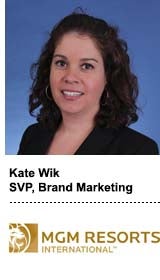
“We’ve always gone to market as individual resorts,” said Kate Wik, SVP of brand marketing for MGM Resorts International. “Now, at an enterprise level, we coordinate our efforts to make sure we’re not cannibalizing our media campaigns or targets and that we’re minimizing overlap so we’re not driving up our own rates.”
To centralize its marketing operations at the corporate level, MGM consolidated its relationships with two agencies: PHD for media and McCann for creative.
But MGM found that operating programmatic in-house brought efficiency and consistency to its marketing strategy. Now, a group of 10 people at the corporate level handle direct response and programmatic for all of MGM’s brands.
“In terms of performance, it’s been fantastic,” Wik said. “We compared revenue growth and spend to revenue to the same time periods in prior years, and we’re improving. Production from our website channels versus other channels is up, which is a very healthy mix.”
Wik spoke with AdExchanger.

AdExchanger: Why did you take programmatic in-house?
KATE WIK: We’ve always done a component of [digital] in-house. We did paid search and a bit of display at the corporate level for each resort. Agencies have complemented that work.
We recently launched our digital marketing platform. Leveraging first-party data made it a lot easier and faster to handle programmatic in-house.
What’s your digital marketing platform?
At the end of 2015, we launched all of our Las Vegas resorts onto a common marketing platform powered by Adobe. We used Adobe Analytics [web analytics], Adobe Test and Target [website A/B testing] and Adobe Experience Manager [content management] to create a standard engine behind our websites and the way they manage transactions.
In 2016 we launched media and targeting. We dove into personalization tools with Adobe Audience Manager [the data management platform], Media Optimizer [the search platform and demand-side platform] and, more recently, we’ve been using their dynamic creative optimization product.
What was the biggest challenge you faced in bringing programmatic in-house?
Centralizing our media buying and planning. We wanted to make sure that our dollars were dynamic and we were able to adjust them based on real-time business needs. For example, if we had a group fall out of a resort, we wanted to have funds to fill that hole.
To do so, we needed to manage those dollars at an enterprise level versus an individual property level. There was a lot of change management. Through the process we’ve seen revenue grow at all of our resorts so they all can tangibly understand the benefits now. But it definitely was a long communication cycle.
Who helped you with the process?
It was spearheaded by Adobe and their consulting services to understand the tools and make sure we’re all plugged into the same system. We had a little bit of talent in-house to run basic display and paid search campaigns. It was more about expanding on that base.
Did you get pushback from your organization?
There was a lot communication. We brought in PHD, McCann and our in-house teams [to run] communication summits to explain the vision, how we’re going to get there and the major milestones.
What do you use PHD for?
We use PHD for a broader media strategy and mix perspective. We leverage them for investment strategy and upper-funnel, offline media. They identify at a micro-level key audience segments [for] travel intenders. They’ve helped us customized the plan, but programmatic execution we do the day-to-day of in-house.
We are so ingrained in our business that agencies are able to provide an outside view and represent the voice of the customer. It’s very easy to fall down a rabbit hole and communicate all the bullets we want to hit, but an agency limits that information and fits it to what the audience is looking for to make sure that we’re resonant and relevant.
How do you decide what channels to invest in and what budget to appropriate?
We worked with PHD on zero-basing our budgets, or taking a fresh approach to media investment. How do we invest in individual resorts and where are we going to get the most efficiency and return?
We did a massive shift from analog to digital over the past year. We’re about 65% to 70% digital. Digital gives you that breadth of the consumer in different stages of their journey and the insights of what’s working in real time. We’re optimizing against placements, channels, sites and audiences on a daily basis.
How do you use first-party, CRM and loyalty data for media optimization?
We’re using first-party data for targeting and customized messaging across social media networks. Facebook Custom Audiences is the best example. It’s not new, but it’s effective.
We use Adobe Audience Manager to build segments in our own profile. We’re able to retarget website users, understand who visited the website and hasn’t booked and what we should be offering them. Have they visited our website in the last month? If so, that’s a different message than we would serve to somebody who was on the site yesterday or has never been on the site.
What can you get better at?
Digital is evolving every day and we need to evolve with it. We’re constantly looking at how we should be structured, who we should partner with and how we can evolve to stay on top of developing trends.
This interview has been edited and condensed.






