


Sometimes, it can feel to B2B marketers like programmatic technology just wasn’t built for them – but the B2B guys are starting to successfully retrofit programmatic to meet their particular needs.
Hewlett Packard Enterprise, for example, and its agency Digitas wanted to use programmatic to power the brand’s account-based marketing strategy and reach key decision-makers within particular organizations.
But there weren’t all that many demand-side platforms up to the challenge, said René Asis, global manager of ad tech operations and platforms at HPE, speaking Wednesday at AdExchanger’s Programmatic IO conference in New York City.
“What we found in the programmatic space today is that there is a lot of black box technology out there and not a lot of transparency in the inventory,” Asis said.
The targeting parameters for a B2B marketing campaign are, by nature, quite constrained, and it’s not easy to scale that data within the bid stream. Only very specific groups of people will be in the market for data storage software, for example, and also in a position to influence the purchase.
Most programmatic buying is centered on the cookie ID, Asis said, but Hewlett Packard Enterprise’s list of prospects was based off of account IDs, and it needed a buy-side partner that could stitch the two together.

To make it happen, Hewlett Packard Enterprise turned to DataXu, whose identity and data management tech allows brands to combine data sets – first-party data, third-party data and user-level cross-device IDs – to develop a universal ID of sorts for consumer and account profiles.
Using the common ID, Hewlett Packard Enterprise’s average match rate was 88%, up from where it previously hovered between 20% and 40%. As a result, CPMs declined twofold for every dollar spent and form fills among targeted accounts increased by 96%.
Optimization and attribution, however, are still quite challenging because B2B sales remain an analog process.
 Hewlett Packard Enterprise models off metrics like cost per download or cost per lead, so using a common identifier makes it possible to match prospects coming in through different channels and track them through the funnel.
But the moment a salesperson enters the picture and starts to nurture the lead, “it could be weeks or months” before marketing knows whether its digital campaign performed or not, Asis said.
And that’s why B2B marketers often just need to roll with the punches.
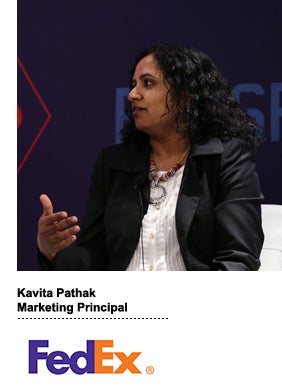
“You hear a lot of sales speak that ‘Hey, your marketing stack is going to work perfectly,’ and you drink that Kool-Aid, but it’s not,” said Kavita Pathak, marketing principal at FedEx.
Not to mention the difficulty of integrating third-party tech with the marketer’s own back-end infrastructure.
But although it “doesn’t feel like programmatic was built for B2B,” Pathak said, marketers in the B2B space can glean insights, value and even ROI from programmatic. They just need to practice the art of equanimity and take the technology gaps in stride.
“You are getting directional inputs from all this work,” Pathak said. “We need to get comfortable in this imperfect world.”







