

 CPG giant Kimberly-Clark embraced programmatic buying in 2011, setting up a “trading desk” that combines in-house oversight with execution through its demand-side platform (DSP), Turn, and its media agency of record, WPP Group’s Mindshare.
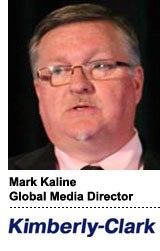
Mark Kaline, Kimberly-Clark’s global media, licensing and consumer services director, detailed the company’s specific approach and its learnings in a presentation this week at the Association of National Advertisers’ (ANA) Media Leadership Conference.
“You’ve got to be a little comfortable being uncomfortable,” he said. “The stakes were high, and we had to start learning about this. We knew we were going to fail and do things wrong, but we’d learn over time.”
The Model
In its vendor and agency evaluation, Kimberly-Clark chose not to use WPP’s centralized trading desk, Xaxis. Instead it worked directly with Mindshare to set up a trading desk that would support only its own brands – such as Huggies, Kleenex and Little Swimmers. The company selected Turn as its DSP and more recently initiated a relationship with video DSP TubeMogul.

First lesson: “Surround yourself with people that can help you,” Kaline said. Through the evaluation and startup process, Kimberly-Clark relied heavily on internal support, working with supply chain management, finance and of course the brand teams, “because it’s their money you’re going to be investing in this process.”
Kaline said procurement was especially helpful, since sourcing and vendor negotiations can take months. “They knocked down some barriers and got us to the right people in some markets,” Kaline said.
Over time, Kimberly-Clark arrived at a programmatic buying program that was neither in-house nor outsourced.
“We’ve got more of a hybrid approach than an in-house one,” Kaline said. “Where we netted out was what I would call a Kimberly-Clark-owned solution. There’s no intention to do this, but if we ever change agencies, we can unplug it and take it with us. That flexibility is something we wanted.”
Keeping the trading desk portable would preserve the optimization it had created over time on Turn’s platform. “We’re able to see our buys learn as they go. You can see the cost per action drop as they run. It’s a circle. We’re now able to use that learning to kick-start future buys.”
Kaline noted the Mindshare relationship is important, and Kimberly-Clark didn’t want to go around its agency. “As long as we own the goods, since you manage our other millions and millions of spend, we’re going to have you run it too.”
That approach also helped Kimberly-Clark maintain a tight link to brand strategy. “We want a trading desk that’s a strategic tool, not just an executional tool,” he said. “By bringing it in-house we needed to make sure we weren’t distancing it from the work our agencies were doing.”
Execution
Getting internal buy-in was easier than you might think. Kaline’s team couched the opportunity in terms of cost savings, an easy way to get past the gate. “We took it to the CMO. He said, ‘What are you waiting for?'”
Outreach to brand teams was a little tougher, assisted by use of a “one-sheeter.” The document started by saying, “Imagine Scottrade or E*TRADE for online media.” And the company found it useful “asking a brand or two to be a pilot, to test it out.”
Once management gave the go-ahead and brand teams were on board, Kaline’s team prepared the soil by writing rules for how Turn should optimize buys. These rules were unique for each brand. “If you put garbage in, you get garbage out. You learn as you go, then the data takes over,” he said.
Today, the program is self-sustaining, but the company still does periodic “health checks.” “Initially there were ongoing meetings, then we made it biweekly, then monthly. I don’t want to burden the organization and agency with daily check-ins.”
Kaline works with two media managers in North America. “They are able to help me partner with the agency to drive the collaboration we need,” he said.
Kimberly-Clark now buys programmatically in North America, the European Union and Israel, and discussions are underway to activate buys in the Middle East/Africa region, APAC and Latin America.
Results
In one effort for its Little Swimmers brand, Kimberly-Clark incorporated a National Weather Service data feed to target only locations where the weather was 70-plus and sunny. In other words, swimmable. “Swim diapers are not in season at the same time everywhere, so waste can be eliminated by focusing on markets that met certain criteria,” Kaline said.
Doing so delivered cost-per-action that was 13% lower than the goal, and survey results indicated “very high” purchase intent of 67%.
It did something similar with Kleenex, targeting ads prior to acute need based on publicly available data during cold and flu season. And to support the Huggies “Potty Breaks” campaign, Kimberly-Clark paired its trading desk with its CRM team to create campaigns bridging known and unknown prospects.
The Future
Kimberly-Clark sees future opportunity for its trading desk in a number of areas, including the rise of “premium programmatic” and “private marketplace” functionality, digital out-of-home, national cable/broadcast television and mobile, especially in select global markets such as South Africa.
“This mobile growth will fuel the global expansion of programmatic [in these places] as well as here in the US,” Kaline said.
Additionally, he called local advertising a “sleeping giant” in programmatic, enabling large brand advertisers to drive hyperlocal messaging. “There is a plethora of under monetized digital assets at the local level. How do you scale that with national advertisers looking to go deep?” Historically, national advertisers get only national solutions from their agencies. This can change with the help of programmatic pipes. “Technology is a huge enabler in this area.”
Kaline ended with some words of encouragement for his fellow advertisers. “You can talk about big data all you want, but what matters to the company? If there are five things that would drive your business, what would they be? You’re going to find you have all kinds of data, some structured and some unstructured. I’m not a technical person, but you have to figure it out.”









