

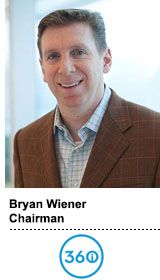
 Not all network agencies are beholden to their holding company trading desks.
Dentsu-owned 360i, for one, “has never spent a dime with Amnet,” said Chairman Bryan Wiener. Rather, it buys all media – roughly $1.5 billion worth – in-house. And programmatic, he said, should be integrated into 360i’s “overall offering.”
360i originally focused on search and social, but expanded its disciplines in 2011 into creative and media services. It later built out a programmatic team led by programmatic VP Kolin Kleveno.
“It’s too complex now to just have a digital team,” said Michael Lampert, SVP of media and account management.
When 360i merged with Dentsu-owned media agency Vizeum in September, it added integrated media planning and buying to its repertoire. It also became a more approachable agency-of-record choice.
“Clients need leadership [to] make their marketing more progressive, but they need to feel comfortable that an agency is not tied to one approach,” Wiener said. “We’re still perceived as a digital agency, so we’re not the safe choice. But going to an old-school agency isn’t the safest either.”
Wiener, Lampert and Kleveno spoke with AdExchanger about 360i’s evolution as media buying becomes a bigger focus at the digitally native shop.
AdExchanger: Do clients generally use you as a full-service shop?
BRYAN WIENER: Most clients don’t integrate creative and media. But once you get outside of the 30-second spot, it becomes more difficult to separate.
Paid, owned and earned should be planned together. Whether they’re managed together is a different story. Undoubtedly the world is moving in this direction. You see all the holding companies smashing together agencies.

Who do you partner with to buy media?
KOLIN KLEVENO: We’re unbiased. We’ve licensed about six demand-side platforms (DSPs), including DoubleClick Bid Manager, The Trade Desk, AOL’s One and TubeMogul. Accordant has their own technology, so we’re exploring that.
How will you work with Merkle and Accordant?
Wiener: They are centralized platforms we can take advantage of. We’re not prepared to talk about [it yet], but I’d be surprised if we weren’t doing some really interesting things. Even if we work with Accordant or Merkle, it will be as an option, not a mandate.
How do you leverage Dentsu’s scale for your media buys?
Wiener: Amplifi is Dentsu’s centralized media-buying [arm] where they aggregate scale. Scale allows our clients to save money as opposed to allowing us to make money. That’s a big distinction between Dentsu’s model and other holding companies, which are reaping what they’re sowing because now the trust factor is so low that they’re scrambling.
(Wiener couldn’t comment on Dentsu’s business practices outside of the US.)
How do you limit partnerships to the tools you really need?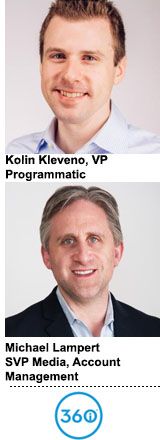
MICHAEL LAMPERT: Every partner we have is partner X, Y and Z. If they perform, they stay; if they don’t perform, they go. We don’t have preferred partnerships, guaranteed spend or take positions in the marketplace. Our goal is not to be the cheapest media seller. That’s for the holding companies.
Kleveno: Other desks have signed every DSP under the sun, but then you become a jack of all trades, master of none. We want to use a platform the best we can. If you have 30 DSPs at your fingertips, you’re not going to be as effective.
We also don’t want to wait for our current partners to develop something if the market is shifting. Last year we found a partner for programmatic native because we saw that was going to be huge. Then our key DSPs developed those capabilities.
Wiener: Once [a feature] gets commoditized you drop [that specialized DSP] because there is a cost of having to learn another platform.
How is programmatic becoming more premium?
Kleveno: There’s been a large shift this year of moving dollars toward private marketplaces. Rubicon purchased iSocket and Shiny Ads and now they have a guaranteed orders platform. DBM is rolling out programmatic guaranteed. But the biggest shift is making the buy audience guaranteed. We’re not moving away from the open exchange, but as programmatic advances, we have more room to do these things.
Are any of your clients paying you based on performance?
Wiener: A number of clients for years have paid us purely on that. There are a couple of issues prohibit performance-based pricing. It sounds great, but they also want cost certainty. Second, there has to be a true sharing of information. When you’re in the pitch process, that’s not always clear.
Lampert: You have to be careful that it doesn’t become another race to the bottom. We believe negotiating rates down and forcing clients into that environment doesn’t add anyone value. The race to the bottom is finally starting to change. We prefer a competitive marketplace where CPMs are decided based on demand.
How willing are clients to share data?
Lampert: We help them figure out how to access, use and structure data. We are happy to play any role between consultative through full-service management.
Wiener: We have a bunch of clients where we audit their infrastructure. A lot of clients have cut deals and their data management platform doesn’t talk to their DSP, they have tags everywhere and it’s a mess. To be successful on their behalf we need to clean that up. That practice is going to grow in the industry as clients take technology in-house.
As the need for media consulting grows, do you see management consultancies as a threat?
Wiener: Undoubtedly they’re going to be competitors. But they haven’t actually pulled levers. Clients have gotten themselves into [problems] because they get advice from people who theoretically understand the environment. Things break down the last mile. That’s where the Bains, McKinseys, Accentures and Deloittes break down.
Lampert: They’re not going to build an entire programmatic practice inside of Accenture because it would be a very expensive, long, heavy investment. That’s why they focus more on creative.
How is TV buying changing at 360i?
Kleveno: We’re using data to influence the plan. We buy over-the-top using audience data. Addressable is still more of a traditional buy. Roku is the kind of buy that most aligns with programmatic.
Lampert: We look at it as consumption-based. Before any dollars are allocated, we look at market-mix models and let that drive our investment decisions. We like to have the data tell us where that next dollar should go, rather than look at some antiquated model.
Wiener: There’s going to be a huge acceleration of video advertising versus TV advertising. I don’t think consumers want 150 channels. A skinny bundle is the way to go. We’re going to get data and ability to deliver in ways that are hard to do on cable. The problem is you have different methodologies for measuring on linear, even for that same show online.
How are you navigating measurement across walled gardens?
Kleveno: We see Google as a little more open. Once you’re in, they keep you in, because their pricing models incentivize you by offering free data, but it’s not by any means that you can’t get out.
The challenge with Facebook is getting data out, but they’re open to accepting things in. We’ve run campaigns programmatically where we’ve targeted an audience watching a video and tagged it with Facebook pixels so when we saw them on Facebook we could show them an ad.
Lampert: They still have to earn their way into our investment. As much as we “depend” on them because their reach and scale is undeniable, we’re still looking at what is next for search. It’s things like Pinterest, in-app search. We have a large seat at their table but we welcome Snapchat trying to take away Facebook’s video monopoly. Competition and independent verification is a win-win.








