

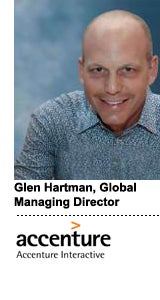
 Accenture Interactive, the $2.9 billion digital and marketing services arm within the massive management consultancy, sees itself as a new breed of agency.
Instead of taking a campaign-based approach, Accenture Interactive instead blends commerce, design and analytics to make marketing more experiential.
“If you looked at the old KPIs for grocery and retail, they wanted to drive more traffic into the store or online,” said Glen Hartman, managing director at Accenture Interactive. “Once you’re there, they wanted you to spend more time at the endcap [the end of the aisle where shoppers often see sale items] so they can send you more promotions. You wanted to increase the shopping cart.”
Now, retail and grocer clients need to engineer around intent. If a loyal shopper frequents a store every Saturday morning but unexpectedly comes in on a Tuesday afternoon, maybe her intent is to get in and out as quickly as possible.
“A lot of people think you need relevant recommendations or right offer/right time, but this goes way beyond personalization,” Hartman said. “This is challenging business assumptions and sometimes means breaking your own rules.”
This shift in client demand is reworking the way brands retain Accenture Interactive’s services in the first place. Traditional pricing models included billable hours or monthly retainers, but Accenture Interactive is noticing a move toward billable outcomes tied to ROI and specific performance objectives.
Hartman spoke with AdExchanger about these changes in its digital business.
AdExchanger: What are the new retail/shopper marketing requests?
GLEN HARTMAN: We’re working with companies today who want to create new affinity programs where you can use your loyalty points as currency to buy all new types of products. You start to take your products and turn them into engaging services, new KPIs.

We did a lot of research with a retail client’s loyalty base and found one thing they cared about most was the consumer just wanted to be notified about what items were on sale everyday. It’s a way to move away from episodic, campaign and promotional ideas to continuous engagement or utility.
Brands are talking about experiences and outcomes more than campaigns. How is this changing their agency retention strategy?
We’re serious about this idea of reverse engineering around outcomes. So much so that we’re actually crafting deals and commercial structures around outcomes only. This is a big change for a consulting company. It’s not time and materials, not a fixed-bid contract, not a rate card. We’re working with an automotive client now where we have a three- to four-year agreement with them, thousands of people working on it, but we only get paid on net new cars sold.
Is that a one-off or are you seeing more disruption in billing methods?
That’s not every client. Maybe we work with a B2B company and we say, “We will increase your lead generation by X amount,” or something really important to the business. We had a client that had a hard time getting their campaigns out on time. If a car company launches a campaign for a President’s Day sale, there was somewhere around a 15-20% on-time delivery. Can you imagine if an email doesn’t go out or a banner doesn’t render and it’s a holiday-based campaign? In this case, we might guarantee [or be paid on the basis of] their campaigns going out 99% on time.
Who does Accenture Interactive compete with? Are you up against the media agency more or the systems integrators?
Everyone knows where the game is: combining design and creative with the technology and analytics. You see different forms of that. There’s a reason Publicis bought five of the top digital agencies. They’re trying to amass more capabilities. You also have marketing service providers like Epsilon, Merkle and then technology companies – system integrators who want to get into consulting. But it’s hard for one firm to go through the continuum of strategy, design, build and run. We think this is where we’re uniquely differentiated.
What’s your approach to acquisitions as competitors like IBM Interactive Experience acquire creative shops?
We’ve invested a lot in trying to redefine what the role of an agency is. The new breed of agency that’s experience-led and reverse engineered around experiences and outcomes speaks to what the CMO and brand managers need to do now. You can’t live off of brand awareness, brand effectiveness and affinity alone. They have to drive sales, engagement and all sorts of new experiences. Accenture Interactive sits at the epicenter of these things both through organic and inorganic growth through acquisitions.
Accenture’s acquired digital marketing services firms like AD.Dialeto as well as creative agencies like Fjord. Do you acquire for functionality, clients or to tackle new geographies?
Our four big pillars are service/experience design, content, commerce and marketing. That’s all powered by analytics and personalization. We are making acquisitions to continue to grow those capabilities. Second, there’s the geo focus. We have most of the capabilities we need at scale, but we want to have that localization because the local, onshore approach for an agency model – where you stay close to the brand – benefits the client.
How do you prioritize tech partnerships? You have a new deal with Marketo, but also do a lot of Adobe and Salesforce implementations.
If you look at the way the ad and marketing tech stacks are aligning, we have all the technology partnerships to do the build out of a “model,” but it’s really about the “run.” So we set up all the software, but it’s the running of the software and all the analytics, the optimization that’s important. We create services – we call it marketing as a service – and that would include programmatic media buying, ad operations. Are we in programmatic? Absolutely. We have a global team working on that as part of a way to get these outcomes. You need it to have better efficiency.
What happens to the future agency model?
We don’t think it’s so much the offline-to-online thing as it is the merger of the agency world with management consultancies. The moment you decide to shift your experience design, you’re talking operating model changes, new organizational design, change management. This is the world of management, process and business consulting. Agencies don’t do that. But we’re not making a Super Bowl commercial anytime soon.
The interview has been edited for clarity and length.







