

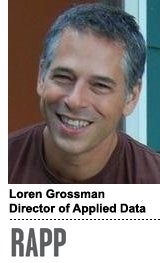
 On Omnicom Group’s Q3 earnings call last week, CEO John Wren waxed poetic for a few minutes about the holding company’s investment in data, calling out a new director of applied data position at agency RAPP.
Loren Grossman, the guy filling out that role, is charged with “deriving actions” from data platforms including DMPs, CRM systems and Omnicom’s in-house intelligence unit, Annalect.
Grossman is global chief strategy officer, a position he retains while adding the “applied-data” duties. A 15-year RAPP employee, he was involved in setting up the agency’s Dynamo data-management platform in collaboration with Annalect.
He spoke with AdExchanger.
What is RAPP’s history with “applied” data?
The application of data for the purposes of driving solutions has been at the core of RAPP’s value proposition for a long time. That’s not new. I founded this group at RAPP called the Strategy Enablement Group. It’s made up of three elements: experience planning; solution leadership, which is almost a consultative piece; and decision sciences.
Decision sciences is equal parts traditional analytics, predictive modeling, regression modeling, segmentation and persona building. And we do attribution analytics with multivariate testing, advance test design and time series modeling. We’ve always had those capabilities inherent in our offering.

What is expected of you in this new role?
So much is happening in the paid media environment, often in the form of nontraditional media experiences that are not measured in traditional ways. There is now an expectation for an evolved subject matter expertise in the ability to apply data for the purposes of crafting more customized and relevant and useful experiences. As well, [we must] be able to measure the impact of those experiences, or of multiple experiences one upon the other so as to understand the whole, which is greater than the sum of the individual parts. The need to do that has become pressing.
What specific enhancements will you introduce, in terms of hiring or other actions?
It’s less about hiring and more about aligning the Omnicom Annalect offering, as an example. There are pockets of subject matter expertise and new kinds of deliverables being offered across the Omnicom network. The idea is a deeper integration and an alignment of those resources.
I’ve worked with [Annalect CEO] Scott Hagedorn for a number of years. His first job here at Omnicom was here at RAPP. Both Scott and I recognized that the opportunity was not simply to create a decision sciences engine within OMD, but to have that engine permeate across various Omnicom companies.
Do you aim to put “applied data” on its own P&L?
That is not necessarily the purpose. The purpose is to create a data and decisioning engine and to imbue all of the various offerings into that. It’s not about buying 50 hours of this team’s time.
That said, we do build products. Dynamo is an excellent case in point. When we do build products, we like to sell those products. There is an element of productizing or creating tools from this offering that not only facilitates new solutions across Omnicom agencies, but in and of themselves can be sold in a media neutral way.
It’s a technology ownership model.
Yes.
We tried to be creative in the ways we offer up the Dynamo solution, one of which is on a shared remuneration basis – almost a cost-per-acquisition basis. We’re so confident in the ability to generate results at a more efficient cost-per that we’ll say, let’s share in the wealth.
How would that work?
If you don’t want to subscribe to it as you would on a SaaS basis, we’ll offer performance-based billing with an incentive for us. We’ll identify a target CPA that might be your current CPA without Dynamo, and then we’ll identify a target CPA we believe you should be able to achieve with Dynamo and we’ll split the difference as a form of compensation.
Where are you in adoption of Dynamo?
It’s early days, but we do have a number of subscribers.
Are you licensing a DSP?
Yes. Much of the technology is our own, but we do of course leverage a number of license partners.
Is “trading desk” the right label?
Not quite, although a trading desk is integrated. But the trading desk is integrated as part of the output. Dynamo integrates push communications – email or CRM-like communications — with paid. But we’re doing all of that off of one platform and having machine-based learning optimize the models and testing techniques on a real-time basis – then pushing it into one dashboard for the purposes of reporting and visualization.
A term we like to use is “customer-level ROI.” Typically we think about ROI at the campaign level. This is at the individual level. We can find a high-value customer and then decide, should we push a retention message to that customer via a display ad, an email, a display ad and then an email, or not at all? The models within these communications are dynamic.
It’s almost like adding an x+1 or a BlueKai functionality to a CRM platform.
Do you compete with the enterprise marketing platforms? Where are the competitive dynamics between RAPP and Adobe, Oracle, Google, Salesforce and so on?
You named a lot of companies there. Do we compete with Salesforce? Not really. We do integrate with Salesforce quite a bit. A number of clients who are Salesforce customers will call us and say, I need a better demand-gen, lead-nurturing platform that dovetails with my Salesforce offering. Annalect has a formal relationship with Salesforce so that leads can be dispositioned directly from Annalect into Salesforce using the same format. What they do is very different from what we do.
With Adobe and others, sometimes we integrate with them and sometimes we compete.
The lines do blur. If I’m a client with a Unica or Aprimo solution, how much of that is approximating something I would do previously with an agency? We still require those platforms. We’re not building our own. It doesn’t make sense for us to do that. But clients are questioning more and more, what agency services do I no longer require because I am no longer subscribed to this platform?









