

It’s been two years since the Association of National Advertisers, working with consultancy Ebiquity and investigative firm K2, dropped a damning report on agency transparency.
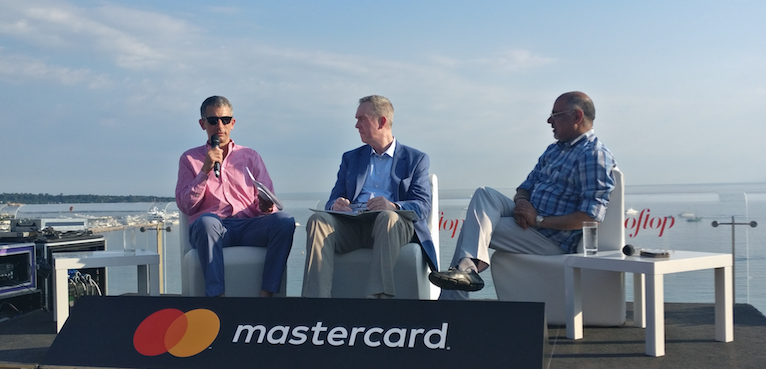
And everything’s better now, right? Quite the contrary, said Bill Duggan, the ANA’s group EVP, during a Cannes rooftop panel hosted by Mastercard.
“Trust between clients and agencies is at an all-time low,” Duggan said. “I’d like to hear someone who feels otherwise, but it’s lower than it’s ever been.”
In a way, the K2 report deepened the rift between advertisers and agencies. When it broke, holding company chiefs made their sense of betrayal known to ANA chief Bob Liodice.
Meanwhile, advertisers weren’t impressed with agencies’ righteous indignation.
“We called it the three D’s: deny, delay, deflect,” Duggan said. “At some point, we’d like the agencies to come clean.”
Advertisers were further alarmed when many agencies said their practices were contractually allowed, that the agency-client relationship was driven by the clauses of their prenup and not by love.
“One thing we learned from K2 is that agencies and clients have different ways of looking at the relationship,” Duggan said.
Some agencies subscribed to the notion that when clients thrive, they thrive, too. Others were all business.
“Many agencies said, ‘Our relationship is defined by the contract.’ Are you effin’ kidding me? That was a wake-up call for our members that it was all about the contract,” Duggan said.

That blast of pure advertiser fury, mostly from US-based companies, was particularly interesting to Alan Rutherford, chairman of Ebiquity Media. US advertisers tend to expect agency-client relationships based on trust rather than contract.
“I remember speaking at the ANA back in 2011 or 2012, saying, ‘Guys you need to be aware of how the trading practices of Europe and Asia are coming into the US,’” Rutherford told AdExchanger. “I didn’t get a great reaction. And by the way, it was no surprise.”
He noted a 2008 Bloomberg article in which legendary GroupM exec Irwin Gotlieb said he wanted to introduce the European practice of rebates into the US.
Yet, the practice was a surprise and, to Duggan’s dismay, remains so to many ANA constituents: “As incredible as this sounds, there are still ANA members handling media who aren’t deeply familiar with the media transparency issue.”
Mastercard CMO Raja Rajamannar agreed that many marketers are still ignorant about rebates.
“There’s a little fear to confront,” he added. “How will the agency react? Will the partnership be affected? And there’s some wishful thinking: If the contract is there, things should be fine, so why rock the boat?”
Also, media transparency is really tough and nuanced, and it’s hard not to think of it in binary terms.
When Jay Sears, Mastercard’s SVP of ad intelligence, who moderated the Cannes panel, asked if transparency should be a negotiated benefit, Rajamannar was unambiguous: “Absolutely not.”
But transparency isn’t simply a matter of defining contractually whether an agency is actually an advertiser’s agent or if it has a principal relationship.
“As a client, if you want more transparency, what does it actually mean?” said Ebiquity Group CEO Michael Karg to AdExchanger.
Are advertisers asking for financial transparency, transparency around data or transparency in media planning or media buying?
“It has many facets,” Karg said. “Each client needs to come to their own conclusion about what’s right for their business and how they’ll compensate the agency.”
Advertisers might demand full transparency, but there’s quite literally a cost to that.
“When that conversation starts, the client starts to understand maybe they haven’t been aware how expensive it is to hire all of these talented people,” Karg said.
At which point advertisers might consider letting agencies benefit from opacity in the trading environment. If the agency is taking a principal position, it’s also the one taking the risk, a point that GroupM’s Xaxis executives have often made.
So, has there been change? Karg says there has. Six months after the K2 report came out and the ANA made its recommendations to advertisers, the World Federation of Advertisers found that 90% of advertisers polled were reviewing their agency contracts.
“It’s a very significant number,” Karg said. “We also felt the [K2] report has educated clients on what the trading practices may be. And the agencies have come a long way, on the basis of the client interests, to move in line with that.”
Yet, it’s clear advertisers are still jittery.
Why else would major companies like AT&T, Bayer, Anheuser-Busch InBev and Tyson Foods be leading the charge into the uncharted territory of blockchain in an attempt to penetrate the murkiness of the media supply chain?









