

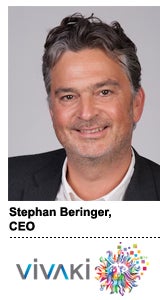
 When French holding company Publicis Groupe decentralized the programmatic capabilities of its agency trading desk VivaKi in February, it did so to capitalize on the increasing performance of programmatic, said VivaKi CEO Stephan Beringer.
While Beringer didn’t pinpoint the exact drivers for the restructuring, “It was the culmination of insights that led to the need to change course, and there was no time to lose,” he told AdExchanger.
The discussions to spread 120 ad traders across Publicis’ agencies began last summer and since then, of the 90 VivaKi employees affected in the US, 34 have landed at ZenithOptimedia, where they merged with its brand teams and serve as programmatic buyers for video and display inventory.
“Clients like having the programmatic folks as part of the same team,” said agency CIO John Nitti. “When I’m dealing with an AOL, a Microsoft or a Yahoo, I can look at the totality of my investment as inclusive of the programmatic portion of my spend and my direct I/O spend on my client’s behalf, and leverage that not only from a data and optics standpoint but also from a method and commercial trading standpoint.”
Others have landed at Starcom MediaVest, Razorfish, DigitasLBI, Walker Media and other digital agencies within Publicis. Outside the US, Publicis has moved VivaKi staff to agencies in the UK, Germany and Australia. The completion date of the new servicing model is slated for Q3 or Q4 in all markets, excluding some hubs like Southeast Asia.
So where does that leave VivaKi?

Despite this movement, Beringer disagrees that Publicis agencies are “absorbing” all of VivaKi.
“VivaKi now has a clear and distinct function, which is helping to drive this notion of technology, data and programmatic as it pivots throughout the whole group,” Beringer explained.
He noted that VivaKi itself is hiring – though “not a lot” – namely a couple of solution and platform consultants and cross-channel analysts. VivaKi and the Publicis agencies wouldn’t confirm a growth rate since the reorg began in Q4 2014, but sources inside the group suggest the number is higher than 30%.
VivaKi will continue processes that can’t be decentralized, Beringer said, such as billing, organizing the stack and aggregating and managing data. VivaKi will continue to operate its media DSP, and will also continue to manage all cloud endeavors across Publicis’ agencies.
VivaKi also owns large parts of the programmatic stack, and will continue to focus on data activation, cross-channel analytics and data, technology and inventory verification – a process called VivaKi Verified that Publicis agencies like ZenithOptimedia will use.
“It would be extremely redundant to have each of the Publicis agencies do that process individually,” said Nitti.
But the key role for VivaKi throughout the reorganization surrounds educating personnel.
“We have a huge function as it relates to training and education,” Beringer said. “This is up and running, and we’re feeding the agencies with content. There are going to be quite significant platforms coming up this year, so that the agencies are able to maintain their level of expertise and also drive it forward.”
His remit, he said, is group-wide, though still anchored in VivaKi: “My role is being the steward and a catalyst as it relates to all reorganizing.”
On top of that, Beringer said VivaKi is developing new solutions in the areas of outdoor and TV. Publicis Chief Strategy Officer Dylan Williams sits on VivaKi’s board to help facilitate the transformation, Beringer said.
“You could say that’s a subtle nuance but it’s actually telling,” Beringer said. “We’re looking at what we’re doing with VivaKi in terms of enablement at all the agencies. This is a mission for the whole group.”
Though Beringer was unable to predict exactly how VivaKi’s role will evolve after the reorganization, he predicted that programmatic methods are going to extend beyond traditional media and that the evolution of programmatic is going to be “a self-cleansing process.”
“What is definitely going away is a lack of understanding in terms of programmatic being a black box,” Beringer said. “Our clients already understand how it functions and the components required.”








