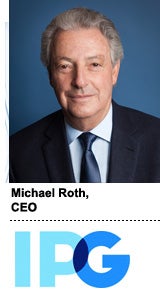
IPG’s $2.3 billion acquisition of Acxiom Marketing Solutions will transform the holding company’s services around its clients first-party data, said CEO Michael Roth said on the company’s Q3 earnings call Friday.
“Acxiom is a world-class data asset,” he said. “As all companies look to make their first-party data work harder for them, and do so in an increasingly regulated and secure environment, Acxiom is considered the premiere provider of these services.”
IPG will begin integrating Acxiom’s solutions into its media-buying unit, Mediabrands, where there are “the most immediate opportunities” for clients, Roth said. But the company will be deliberate in rolling out AMS capabilities to the rest of the group.
“We’ll get comfortable with [media] and then roll it out to creative and all of our other agencies,” Roth said. “You can’t do this all at one time. We don’t want to do anything stupid.”
Roth added he sees opportunities to use AMS insights and expertise in working with first-party data to help its creative agencies craft personalized communications.
“Our creative people have their own data and analytics to reach consumers with the right creative that is relevant and trustworthy,” he said. “When you overlay the first-party data Acxiom can bring, it just makes it more powerful. Coupled with media planning and execution, that’s the holy grail of our business.”

IPG will also embed AMS capabilities across PR, experiential and digital agencies to “deliver foundational data management capabilities to our clients,” Roth said.
“Increasingly, our largest clients have tasked us with creating cross-channel brand experiences that leverage their first-party data, advertising and marketing technologies, as well as creative insights,” he said. “With Acxiom, we are better able to answer that need.”
While Roth didn’t specify any client work involving AMS, he mentioned it were part of UM’s recent successful pitch for the American Express business.
“[UM was] very competitive even before the Acxiom transaction,” he said. “This just made it even better. You can count on that in more pitches going forward.”
IPG won’t realize any revenue impacts from the acquisition just yet, but AMS is on track to hit the 5% growth target set by IPG this year.
“You don’t take a $2 billion transaction and all the sudden the synergies are there from day one,” Roth said. “But we don’t see any holes in our offerings, so there’s no need for us to go out and do another transformational transaction like Acxiom.”
Overall, IPG had a solid quarter, with net revenue organic growth at 5.4% to $1.9 billion. The company is on target to hit its 4-4.5% growth target for the year.
CPG stamina
CPGs are coming back to IPG.
The company called consumer goods one of its strongest-performing sectors for the quarter, along with technology, telecom, financial services and health care. The latter makes up 25% of its business.
“We continue to see an improved tone of business from CPG clients,” Roth said.
IPG’s success comes from its decision to double down on its agency brands rather than consolidate agencies like competitors have, such as WPP, Roth said.
“We believe in our brands and continue to invest behind them,” he said. “This becomes extremely important when others are disinvesting in their brands.”
IPG is also accommodating the in-housing trend by helping clients take pieces of programmatic inside their organizations, though few clients are doing so.
“It takes a lot of money to maintain that investment over time and that remains to be seen how many clients are going to be able to do that,” Roth said. “That’s nothing new to our industry and we know how to deal with that. We haven’t seen as dramatic of an increase as everyone is talking about.”