
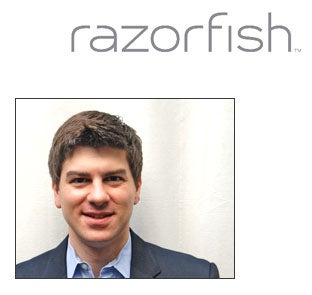
Matt Greitzer is VP of Search Marketing and Head of ATOM Systems at Razorfish.
 AdExchanger.com: What can you tell us about momentum in Razorfish’s ad exchange practice? Any year-over-year comparisons that you can draw?
We’ve only been in market for about nine months, so it’s too early for year-over-year comparisons, but we’ve seen consistent month over month growth since launch. Initially demand was strongest among pure-play direct response advertisers, but recently we’ve started to see real interest from more traditional brand advertisers who are intrigued by the insight and targeting capabilities they can access in the exchange environment. So overall I would say the momentum is strong and getting stronger.
Why are demand-side buying platform strategies taking hold for agencies?
A confluence of events are driving this change, but most significantly among them are the emergence of ad exchanges as a major inventory supply source. Previously if an agency wanted to aggregate demand and make that actionable they had to take an upfront position in inventory. Most agencies aren’t comfortable taking upfront risk so they couldn’t scale these efforts. The ad exchange channel allows for massive inventory aggregation while limiting the risk of getting stuck with unsold inventory, so the economic barriers are easier for an agency to clear. Beyond that, there is a desire to reverse the trend of declining media commissions, an increasing demand for insight and repeatability in display media buying, and a number of technology players who’ve emerged in the last 12-24 facilitating agencies’ entry into this space.

Tell me about ATOM Systems. What is it? How did it begin?
ATOM Systems is Razorfish’s buy-side demand platform. Our service offering is pretty simple: we aim to provide the performance and scale of an ad network with the client-focus and insight of an ad agency. We have a small team based out of our New York office and to date we are live with over twenty clients. At present we operate exclusively for the Razorfish client base. Interestingly, ATOM Systems began as an exploratory exercise to figure out what the heck was going on with the development of ad exchanges and what this would mean for our business. Joanna O’Connell on our team, who was a Media Supervisor at the time, was involved in this effort and saw the potential for revolutionizing the way display media is bought and optimized. I was interested from the search marketer’s perspective of micro-segmentation and targeting, and together the two of us got enough buy-in from our senior management to let us run with it. We launched our first pilot campaign in November of last year with the ready, shoot, aim approach. By January we had a solid business plan, strong client demand, and were off to the races.
Let’s talk about billing.. the dark alley of the agency world. Traditionally, holding companies/media agencies need to contract with each media source such as an ad network or a publisher when making a buy. Now, the agency is moving to demand-side platform world where different media sources are being bought on the fly in a real-time, spot marketplace. Can agencies adapt? How is Razorfish going to solve this issue?
Some of the exchanges work like a clearinghouse, so there is no need to sort through publisher invoices. For those that don’t, to date we have been working with platform providers to provide that service for us. Our accounting department was acutely aware of how painful this process could be, so we have sought to avoid it as long as is practical. Eventually we may have to take some of this on ourselves which will be a resourcing issue, but something we think we can support given the additional value we are driving through the ATOM business. We did this in past, too, when we built DRIVE so it’s not totally foreign to us.
What do you see as the impact of Publicis’ purchase of Razorfish as it relates to the ad exchange practice? Will it fall under the umbrella of the VivaKi Nerve Center, for example?
I know Publicis has been doing some interesting things in the space through the VivaKi Nerve Center. Beyond that there isn’t much I can say at this point, but maybe we can do a follow up post-close!
Does search marketing merge with display at some point? How many more case studies on display positively impacting search campaigns do search engine marketers need?
I thought this would happen much sooner, but it hasn’t. Interestingly enough, I still don’t see the search marketing community embracing the ad exchange channel, so now we are in a position where we potentially have three different disciplines all executing against the same goal. I’m not sure this is a bad thing as long as there is tight collaboration on the tactical side and a uniform approach to data and analysis. Neither of these things are easy to do, or do well, but we are working hard at Razorfish to make sure we aren’t creating new silos.
Ultimately, I think it’s advertisers who drive this. The minute they demand integration the agency world will respond to that. To date they haven’t done so, at least not consistently.
What are you doing to educate your clients in this increasingly automated media trading world? Any pushback from clients due to fears about brand safety, etc.?
Our client base tends towards the quantitative side of the business, so they are naturally receptive to the opportunities the exchange landscape presents. The industry is so new and so dynamic that to date we have been pretty successful simply educating our clients about the key players in the space and the new capabilities at their disposal. We do have a few clients, those in the direct mail space or with rich offline customer segmentation schemes, who have been especially aggressive and have helped us to conceive of new executions. That’s an interesting dynamic because the space is so new if you can demonstrate buy-side demand the platform and data providers will often customize to meet the need. The space won’t always be this malleable but right now there is a huge amount of testing and experimentation going on and I think we’ve been at the forefront of that.
In terms of pushback, brand safety is the single biggest obstacle. In almost all cases we have been able to come up with some kind of program to alleviate brand concerns, but scale can be limited. This is probably the biggest barrier to growth in the exchange industry. Full site transparency would be the best solution, but since that isn’t likely we see a pressing need for some kind of independent auditor who can vet inventory quality. Entrepreneurs, take note.
Should agencies build, buy or license ad technology in-house? Why?
Given the early stage of the industry and the pace of innovation in the space I think the licensing option is going to be preferable in the short term, and you’ve seen most agencies adopt this approach. Longer term, assuming the agency has the cultural DNA and the tolerance for investment I think building in house is an option, as is buying (which is just an accelerated version of the build strategy). We may evolve to a place in the industry where the technology (i.e. API connections, real-time bidding capabilities, etc.) is commoditized but the decision making behind the optimization decisions are in-house and proprietary. This would more closely mirror the evolution of the financial services industry so if you buy that analogy it’s a compelling view of the future.
Is real-time bidding through exchanges and demand-side platforms a feature that will be a game changer? When does it “hit” for clients in your estimation?
I think real time bidding is an exceptional feature enhancement with myriad befits for advertisers, but I wouldn’t call it a game changer. The real benefit of the exchange environment is already manifest with biddable supply, at scale, in a spot market format, combined with the ability to decouple data and inventory. RTB just allows buyers to make better use of these benefits. It’s like HDTV versus regular TV. Not game changing, but much, much better.
Is creative taking full advantage of technology? If you were running a creative agency right now, what strategies would you put in place to ensure a successful future?
Exchanges aside, I think there are some very innovative creative/technology collaborations and from what I’ve seen the creative community is often first to embrace new technologies in the testing and experimentation phase. We’ve done some really interesting and innovative things with advertising on the iPhone, for example, taking advantage of the motion sensors built into the device to create an interactive creative experience for the customer. If you are talking about exchanges specifically, I think there is much more we can do to align our targeting efforts with our creative strategies and executions. Doing this in a cost-effective way can be a challenge, but the upside will be huge.
Looking towards the future, there is always going to be a strong market for relevant, high quality creative that connects with the consumer. Creative agencies who are doing this well have nothing to worry about.
Follow Matt Greitzer (@mattgreitzer), Razorfish (@razorfish) and AdExchanger.com (@adexchanger) on Twitter.






