
How will agencies survive if there is no agency of record?
After reading a recent Advertising Age story from Kunur Patel about “the dropping” of three digital agencies of record in favor of a competition of ideas between three others, one might justifiably wonder how is the agency going to survive in this climate. Have ideas become commodotized? (How about in 2010 we try not to use any form of the word “commodity” just for the heck of it? I’m game.) This week, in a thorough article, Patel suggests that it’s a digital agency phenomena.
Hmm, ya think it’s just digital? From here, it appears to be the entire ball of agency wax.
At ad:tech Chicago this past September, a Sears marketing executive said that, in general, he prefers the competition of ideas rather than devoting all his business to one agency. Ideally, who can blame him? … as long as agencies can continue to survive and actually compete for his business. If they can’t, he’s S.O.L. as – more than likely – he’s bringing the whole agency in-house. Good luck with creativity and innovative thinking at that point.
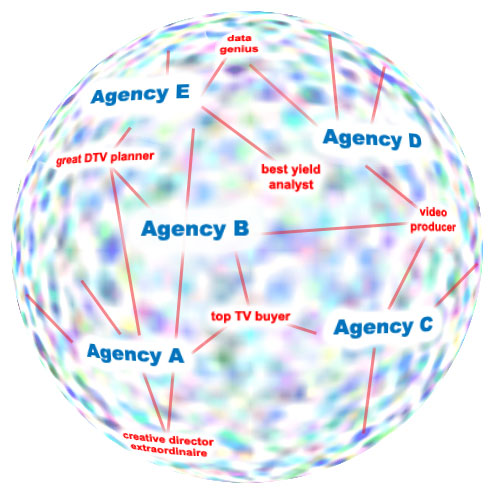

How does this new competition model get serviced? If an agency cannot predict its revenues, how do they hire? Can they even commit to a lease for a swanky office space? Nope.
From here, the future agency becomes virtual and led by superhero planners and creative thinkers. Behind the superheroes, it’s all virtual. All shared.
Ironically, with the fragmentation of the agency model, it comes together. Each agency offers creative and media services under one roof – whether digital or traditional – which is enabled through a network of expert relationships (the TV buyer, the Creative Director, the Information Architect, etc.) which only start billing if the contract is signed. And like it or not, the client may get the same digital media planner between Agency A and Agency B, for instance.
Differentiation will be measured at the tip of the agency spear in a combo of unique managerial skills and creativity – where ideas and their makers and managers merge. And, the virtual, just-in-time network behind them will be more highly-skilled than ever. You’re not gonna get hired if you’re not any good.
What do you think?
By John Ebbert, Managing Editor, AdExchanger.com







