 Automation Is Coming.
In panel after panel at New York’s Advertising Week, publishers and agencies heaped hate on ad selling inefficiencies and delivered eulogies for their mutual adversary, the insertion order. The big questions: Which players will be first to seize the automation grail? And how long will it take?
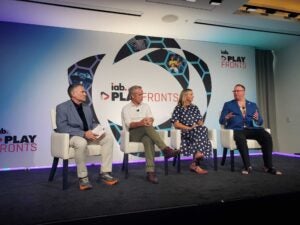
The holding company trading desks are still in contention, five years into their version of the programmatic story. Kahunas from the five biggest desks convened for a Thursday panel discussion moderated by Jay Sears, GM Revv Buyer for Rubicon Project. This was the fifth annual trading desk program at Advertising Week and, fittingly, the discussion had moved from the event’s smaller venues to the Times Center main stage.
Let’s recap, shall we? But first, the lineup:
- Michael Brunick, SVP Programmatic, Magna Global (IPG)
- Paul Dolan, SVP Global Business Development, Xaxis (WPP Group)
- Josh Jacobs, Global CEO, Accuen Media (Omnicom)
- Adam Kasper, Chief Media Officer, Havas NA
- Kurt Unkel, President, Vivaki AOD (Publicis)
- Moderator: Jay Sears, GM Revv Buyer, Rubicon Project


“Welcome to Programmatic Ad Week,” intoned Sears at the outset. (True that. During the week AOL hosted a Programmatic Upfront and IPG’s automated TV-buying consortium gained steam with the addition of ESPN.)
The kick-off question: How much of each dollar you spend is “automated” today, and how much will be in 2015?
IPG’s Brunick, who has repeatedly thrown down the gauntlet on TV automation, says $0.05 to $0.07 per dollar goes to automated or programmatic channels today. By 2015, he reaffirmed the projection that IPG will automate a clean half-dollar.
Paul Dolan of Xaxis says of IPG’s 50% claim, “That’s a big number.” Xaxis automates less than $0.05 on the dollar. Because WPP manages $90B in spend – “at least for one more year, still the largest” – it would be impossible to automate half of that within two years. By 2015, “we’re looking at between $0.07 to $0.10” of automation per dollar. Conservative!
Accuen’s Josh Jacobs says his agency, which services PHD and OMD, is automating close to 15% today. He’d like to see that rise to above 50% on digital. “The rest we’ll see.”
Adam Kasper, of Havas, says the French company’s Affiperf trading desk today automates 4 to 5% of total spending. On the digital side it will approach 45% in two years. Factoring in traditional, he says 2015 will see about $0.15 on the dollar being bought programmatically.
Vivaki President Kurt Unkel says 20% of aggregate digital spend goes through programmatic channels today. The “near horizon” goal is 40 to 50%. No specifics on television spend.
Programmatic Versus Workflow
The discussion dives into the difference between “programmatic” versus “workflow automation.”
“Programmatic is a very large component” of automation, says Brunick.
Jacobs says too much focus on workflow detracts from the audience “magic” possible with programmatic. “Workflow automation is a way to buy the exact same thing you were already buying through a more efficient process. If you focus entirely on cost … you’re not looking necessarily at how valuable those customers are once you get them.”
Whatever you want to call it, Xaxis’ Dolan believes workflow efficiency creates “more margin” for agencies.
Sears asks the obvious followup: So cost savings accrue to the holding company, not the advertiser?
“Workflow automation might be interesting to the people in this room,” Dolan elaborates. “But it’s like we’re talking to ourselves. I equate it to a plumber or carpenter who’s using electronic tools or hand tools. As long as they fix your plumbing, do you really care as a client how they’re doing it?”
He adds, “Clients aren’t saying, I need somebody who has an automated workflow. They want to use data and technology to reach the right audience.”
Ad Network Issues
Question for the panel: Are ad networks your biggest competitors for budget? Three said “yes” (Vivaki, Havas, IPG), and two “no” (Accuen, Xaxis).
And another: Does your group administer ad network budgets? Same split: three “yes,” two “no.”
How to convince operating-agency teams to shrink the number of ad networks they use? Havas’ Kasper cites two core arguments. First, consolidating into one platform creates an analytics edge. Second: “The networks have very large and pretty opaque if not completely blind margins. Our argument is that the trading desk, with a transparent relationship to client, can bring the same media for lower cost.”
Publisher Pain
Sears says the trading desk is becoming the “Jenny Craig” of the holding company, slimming down bloated media plans in which “small-value paper IOs are being sprayed around like candy shooting out of a piñata at a small child’s birthday party.”
Should publishers and ad networks fear the coming shrinkage?
Kasper says no, there’s a great benefit to publishers that receive that consolidated spend. According to Unkel, Vivaki has one financial client that runs completely custom site lists.
Sure, relationships matter. But there just won’t be as many of them. IPG plans to slim down from 200 ad networks to 40, and up to 2,700 publishers will be cut from its direct buys.
That’s a lot fewer partners. But! “We’re going to spend more money on more sites,” Brunick said. “Direct IOs are not the answer for distribution to thousands of websites.”
To stay on IPG’s site lists, selling programmatically is “critical.” Even better if media sellers can reduce internal conflicts of interest by breaking down the barriers between commission-based direct sales and programmatic.
Xaxis has 35 active publisher relationships in the United States. “The publishers are the ones that internally have aligned their teams to grow the overall pie rather than be siloed,” says Dolan.
Brunick agrees, “You create internal conflict and angst by shifting budget from direct to programmatic.”
Xaxis already buys loads of digital media upfront. (AOL, eat your heart out.) “It’s about giving clients advantage over someone who’s buying in open marketplace,” Dolan says.
Another pain point for publishers: With execution of media buys residing dually within the trading desk and operating agencies, will websites and networks have to “sell twice?”
Brunick again: “I bristle at the word ‘selling.’ This should not be about price. The entire premise of there being a buy side and a sell side is part of the problem.”
Other panelists agree it’s all about the integration. And that applies to internal holding company dynamics as well. The trading desks are progressively more “embedded.” Goodbye, hub-and-spoke.
AOL’s Commitment
A final speed round question for the whole panel: Would you rather have a “programmatic upfront,” or an “upfront with programmatic?” This is basically an invitation to rag on AOL.
Brunick says, “An upfront with programmatic.”
Dolan agrees: “That’s how we do it.”
Jacobs demurs: “AOL deserves a shout-out. It doesn’t matter what it was. What matters is a really big publisher said, ‘We want to do business this way.'” Applause!
Unkel: “An upfront with programmatic.”
And that’s a wrap!