

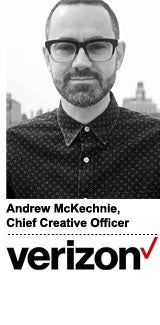
When Andrew McKechnie left the role of global creative director at Apple to become Verizon’s first-ever chief creative officer in February 2017, he had a tall order.
McKechnie, who reports directly to Verizon CMO Diego Scotti, was tasked with developing the brand’s own in-house creative agency.
Named 140, after the group’s digs at 140 West St. in downtown New York, the unit now employs 150 across creative production, project management and strategy.
Rather than divorcing from its agencies, 140 takes a hybrid approach, meeting daily with external partners in “focus” rooms comprising its open office floor plan.
The agency now manages certain functions, such as device and hardware brand photography, entirely in-house, rather than outsourcing it to outside partners.
The move has helped Verizon approach production more systematically.
“The challenge is how do you become more consistent, but be disruptive at the same time,” McKechnie said.
Although McKechnie’s team is primarily focused on creative, he regularly sounds off with Verizon’s experience team, which just acquired the design agency Moment, and CMO Scotti, to help convert creative ideas into media, marketing and experience strategy.
McKechnie spoke with AdExchanger about the agency’s hybrid approach.
AdExchanger: What was it like transitioning from consumer electronics to telco?
ANDREW MCKECHNIE: [Working] at Apple showed me what can happen when you have a fully integrated, in-house group that can impact the work end to end.
Coming to Verizon, [the challenge was how to] take some of the aspects of a fully immersive in-house agency like the one Apple’s created and balance that with the amazing external agencies and talent we have.

What’s 140’s priority?
Our focus is about getting back to the roots of who we are as a brand, our voice and how we appear to consumers. Those things are sometimes lost along the way, and every brand goes through this along their journey.
It used to be that one big holding company did everything. But the way media and marketing has shifted, it fragmented a lot of brands very quickly because the marketing budget got sliced into all these different areas like digital and social and mobile.
Creative used to be about that big idea for television or print. How has your job changed most, given all the emerging channels?
It was probably easier for everyone to say, “Hey, we’re going to create a single script and a 60, maybe a 45 and definitely a 30.”
We’ve shifted our strategy to do more of a combination of 30s and 15s within broadcast, which gives us the frequency but also the ability to tell a different kind of story. Maybe we do a 15-second ad and zero in on a unique thread or product dimension in a six-second Snap. It gives you greater dimension in storytelling.
How have technology and data changed creative most?
The way we’re approaching creative and building a brand is still very much rooted in the core disciplines. The tech platforms have just given us another vessel to express a story.
Sometimes people get blinded by some of the technology and platforms and fail to go back to the roots of, “Do we have strong product positioning and a really creative idea to lean into?”
Verizon has made omnichannel a huge priority across marketing and your customer experience group. Who’s leading that charge?
It’s something we believe in across the organization and our CMO [Scotti] is driving that through the marketing organization.
The reason we started with retail and digital is we want to be able to create a more consistent experience across both those worlds. If you look at the new wireless home page, you’re seeing those two worlds becoming much closer and they’re organically starting to feel like one brand.
So if we are promoting the latest [Google] Pixel, for example, when you go into a store, you’re being communicated with in a way that’s relevant for that medium, and when you go online, we’re continuing that narrative and it’s in a form that feels like the right time and place for that message.
What benchmark for success do you grade yourself on?
If I can get people to change their perception of what a wireless company is or can do, that would be pretty amazing. The way people view carriers is very rigid and to shift that perception is going to take a lot of work. My ultimate ambition is to get people to perceive us in a way they never expected.
Interview condensed and edited.







