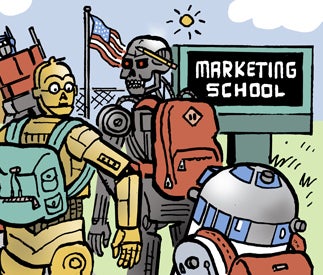
The long-awaited Googlebots are here.
Which is to say, Google on Wednesday announced the full availability of its new agentic AI tools, called Ads Advisor and Analytics Advisor.
Google debuted the two in-platform chatbot solutions at Google Marketing Live in May and is now rolling these bots out to all English-language accounts, Google VP of Global Ads Dan Taylor said earlier this week during a press Q&A session.

The products are built into Google Ads and Google Analytics, respectively, as a baseline feature for all accounts. The Ads Advisor is an “AI expert that generates fully personalized recommendations and automates complex tasks,” Taylor said, while Analytics Advisor acts as “a personal data-driven analyst that fits right inside Google Analytics.”
The two new agentic platform tools are also part of a broader years-long trend of Google advertisers incorporating AI into their workflow.
Performance Max, the company’s main AI-operated campaign product, has more than one million advertisers, Taylor said, while two million different accounts now use some form of Google’s AI-generated creative capabilities.
So, what do they do?
The Ads Advisor has a few key use cases to start. It speeds up the pace of a campaign by taking an advertiser’s broad goals – sales and other business metrics – and turning a loose campaign brief into a media plan that can be activated almost instantly. The AI then handles campaign optimization, like recommending new media channels or search terms.
The AI also acts as a “powerful brainstorming and generation tool” for new creative strategies, Taylor said. Since millions of advertisers do opt into Google’s AI-generated creative tools, the product can edit or generate new text, image and even video assets.
These services are particularly useful for smaller advertisers that don’t have marketing teams and in general “are trying to spend more time running their business and less time running ad campaigns,” he said.
One easy benefit, for example, has been simply to prompt advertisers early in the campaign setup process whether their preference is to target search intent or particular audience demographics. These types of inputs “have helped spark” the AI later on in the campaign to understand what to prioritize, Taylor said.
With the Analyst Advisor, Google is targeting large advertisers or site operators that want to remove the manual processes of pulling data and the data science knowledge that’s often required to analyze large data sets. Now, Taylor said, advertisers can use natural language prompts and the platform agent will prepare reports.
The new in-platform chatbots are “freeing up marketers to focus less on troubleshooting and data pulling and the hands-on-keyboard work, and more on what they do best: strategy and creativity and driving real-world results,” he said.
On the other hand, strategy, creativity and driving real-world results are also now within the province of platform agents.
AI’s time to shine
Taylor has been at Google for 20 years now. That’s before the first iPhone was sold, not to mention the whole concept of streaming media.
“And I’ve never been more excited about the opportunity for advertisers today,” Taylor said.
How so? After all, a general temperature-taking of the sentiment of legacy brands, digital-native brands and advertisers of all stripes would likely reveal a mostly downcast, pessimistic lot.
“I think we’re at an expansionary moment with AI on a couple of fronts,” he said.
As a search engine, Google sees how consumer AI products are reshaping how people look for things online, traffic the web and eventually make a purchase. Search queries have become longer, more complex questions or series of questions, he said. The gap between product research and a purchase is collapsing.
And it is harder for brands to anticipate what will work and what types of keywords drive results in this new category, Taylor acknowledged. But embracing AI as a marketer, like with these agentic advisors, can “allow advertisers to move at the speed of the consumer during this expansionary moment.”
The world may seem complicated for marketers. But giving directions to a chatbot isn’t complicated.
As Taylor said when introducing the new agentic advisors, “AI and emerging capabilities hold the potential to improve and simplify the business of advertising.”