

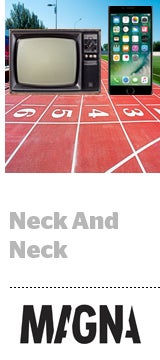
 By 2017, digital advertising spend will catch up with linear TV at $68 billion, according to Magna’s latest update to its US ad revenue forecast.
But linear TV isn’t going anywhere just yet.
“This year what has surprised me is the resilience of national TV,” said Vincent Letang, EVP for global market intelligence at Magna. “In our June update we saw that national TV was having a good year, but this is a confirmation.”
National TV ad spend grew 4.6% in the first half of 2016, compared with a 0.5% decline in the same period last year. But as TV remained strong, digital ad spend grew 15% this year and is forecast to grow 12% next year.
“Both national TV and digital have done very well this year,” Letang said. “That goes against what some people thought, which was national TV is doing well because people are putting money back into TV at the expense of digital media.”
In reality, TV has seen a bump in ad spend due to CPM inflation on a shrinking pool of supply.
“As supply shrinks, the laws of supply and demand apply, and pricing goes up,” Letang said.
While advertisers are spending more on digital, verticals like CPG, auto and food still rely on the mass reach that linear TV provides (a state of affairs that Magna forecasts will continue for at least the next five years, until digital targeting and measurement improves further).

“They want absolutely to secure that share of a shrinking supply” of television, Letang said. “They are ready [to spend more] because they don’t feel that they have a good enough substitute in the market. … You still need to build your campaign on national TV if you are launching a new product in one of those verticals.”
Local TV faces a similar erosion of supply, but it’s not seeing the same price inflation as linear TV because local businesses are shifting more money to mobile search and social. Excluding the 2016 election (local TV dominates political ad spend), local TV advertising would be down -1% this year to $20 billion.
But local cable TV shows promise in its targeting capabilities at the household level.
“Household addressability is attractive to political advertisers, but also auto and finance,” Letang said. “Within local TV, those capable of superior targeting will continue to grow.”
Despite TV’s resilience, Magna said digital will outpace the medium by 2020, when it is expected to reach 51% market share at $105 billion. TV ad spend growth is expected to slow to 1.5% next year.
Magna attributes digital growth in the first half of 2016 completely to mobile, which saw 45% growth as desktop declined -0.6%. Social media grew 43.7%, followed by digital video at 31.7%. Social video was the strongest growth category within all digital segments at 162.5%, and is forecast to continue growing 100.2% in 2017.
Overall, digital ad spend is expected to grow to $179 billion this year, the strongest growth rate since 2010.






