
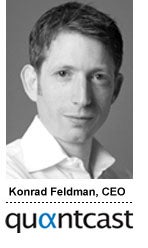
 Although Quantcast has often discouraged observers from attempting to group the analytics provider into the “ad effectiveness” category with comScore, Integral Ad Science (fka “AdSafe”), DoubleVerify and others, its acquisition this morning of MakeGood Software would appear to put the company in closer competition with those parties.
In a post on Quantcast’s blog, CEO Konrad Feldman said that adding Makegood’s products to its existing data gathering abilities will provide more in-depth and user-friendly reporting on ad campaigns delivered by Quantcast Advertise to its advertiser and media agency clients.

To be sure, as a Quantcast rep told us, acquiring MakeGood does not put Quantcast in direct competition with the aforementioned ad effectiveness players as MakeGood’s software will not be offered as a distinct Quantcast service. Instead it will be integrated into Quantcast’s existing products and, while it will help improve ad effectiveness, that will only be so for Quantcast Advertise campaigns, not for anyone else.
So why did Quantcast make the deal (the price of which remains undisclosed)?
“In 2012 we surveyed the market, identifying and examining tools we might use to enhance our integration of campaign-related data and our associated reporting suite. We were very impressed by what the team at MakeGood had created,” Feldman said. “Their understanding of complex multi-system reconciliation and reporting was immense, and the elegant software they had created delivered a high degree of automation for this central industry challenge.”
Seattle-based Makegood was founded four years ago by Jeff Coon, who was previously director of ad sales at CarDomain.com. The team remained fairly small over the years with roughly five people on staff.
When asked last year if Quantcast wanted to be seen as an “ad effectiveness” specialist, Feldman told AdExchanger that he did not, arguing that he only wanted to help clients better understand how to apply “big data” in real-time. Makegood’s Coons has said that his proposition has been to merely simplify the process of gathering data as well, all with the promise of reporting on the success of campaigns.
If ad effectiveness means looking at how well a digital campaign did after the fact, then, yes, Feldman’s stance that Quantcast should not be lumped into that service area makes sense. But as ad effectiveness comes to mean anticipating what is most likely to be the most optimal buy for a marketer and an agency, then this deal should put Quantcast in close proximity, at the very least, to ad effectiveness providers.
As Feldman writes, “The increasingly complex nature of real-time advertising means advertisers require better tools to properly understand and attribute ad campaign success and optimize their budgets. A significant portion of advertising technology development has focused on automation and optimization related to the delivery of individual impressions, but industry participants also face significant complexity in aggregating, organizing and reconciling campaign data to form a single view of truth in order to make critical business decisions.”






