
The digital audio market is becoming more programmatic, with dynamically inserted podcast ads leading the way.
But, as programmatic buying becomes more common in audio, marketers and audio platforms are falling into the same habits that have long been decried in programmatic display advertising – namely, the temptation to cram in as many placements as possible.
This issue was front and center at the IAB Podcast Upfront and the Sounds Profitable Business Summit, both of which were held in New York City last week.
Connecting the pipes
The entire digital audio channel – including podcasts, plus streaming radio and music – drew $8.4 billion in ad revenue in 2025, representing a 10.2% growth rate compared to 2024, according to the IAB. The IAB predicts podcasting ad revenue will grow an additional 8.7% this year, while non-podcast audio will grow by 3.6%.
Meanwhile, the number of ad agencies that buy audio programmatically has grown from 41% in 2022 to 82% this year, based on a survey of more than 300 agencies conducted by Advertiser Perceptions and Cumulus Media/Westwood One that was released in May.

Much of audio’s programmatic growth in recent years can be attributed to major DSPs like The Trade Desk integrating with audio platforms and making it easier for advertisers to match listeners to the users they target in other channels.
However, the audio channel still had plenty of programmatic pipes to lay before it could fully connect to agencies’ omnichannel strategies.
For instance, Amazon DSP just integrated inventory from major podcasting platforms SiriusXM, Spotify, Acast and iHeart Radio in June and July this year. Billy Hartman, head of enterprise partnerships and revenue at Amazon-owned podcasting platform ART19, revealed this news during a presentation at the IAB Podcast Upfront.
Prior to this summer, advertisers could only access Amazon’s hosted podcast supply through the ART19 platform, Hartman said. Now, making those third-party audio platforms available in Amazon DSP gives advertisers a simple way to “buy programmatically across the open internet of podcasts,” he said.
The expanded ease of access is allowing more advertisers to supplement direct-sold host-read podcast ads with dynamically inserted programmatic placements, said James Vakula, director of programmatic at podcast advertising agency Oxford Road, during the same Podcast Upfront presentation as Amazon.
Increasingly, Oxford Road sees advertisers running a 70/30 mix of host-read and programmatic ads, Vakula said – although which strategy gets the larger portion depends on the brand’s goals, he added.
But generally, Vakula said, host-read ads make sense as the first entry point for a brand to grow awareness and audience trust through more popular podcasts. And then programmatic ads help keep the brand top of mind through subsequent exposures and across mid- and long-tail audio inventory.
Advertisers also now have more opportunity to run dynamically inserted host-read ads across a podcast’s entire backlog of shows using impression-based targeting tactics, rather than just by targeting at the episode level, said Cam Weber, senior director of partnerships at audio measurement platform Podscribe, during a different presentation at the Podcast Upfront.
However, he added, impression-based targeting can quickly ramp up ad exposure. “From an episodic standpoint, listeners are generally hearing one ad per episode. But over the course of a campaign in an impression-based buy, a listener could hear more than 15 ads.”
So, when it comes to balancing reach with exposure for impression-based audio campaigns, quipped Matt Drengler, head of partnerships at Podscribe, “Frequency caps. That’s all I’ll say.”
Keeping the ad load light
The subject of digital audio’s growing ad load also came up in a fireside chat hosted at the Sounds Profitable Business Summit between Greg Glenday, CEO of podcast platform Acast, and Krystina Rubino, GM of offline and audio at independent growth marketing agency Right Side Up.
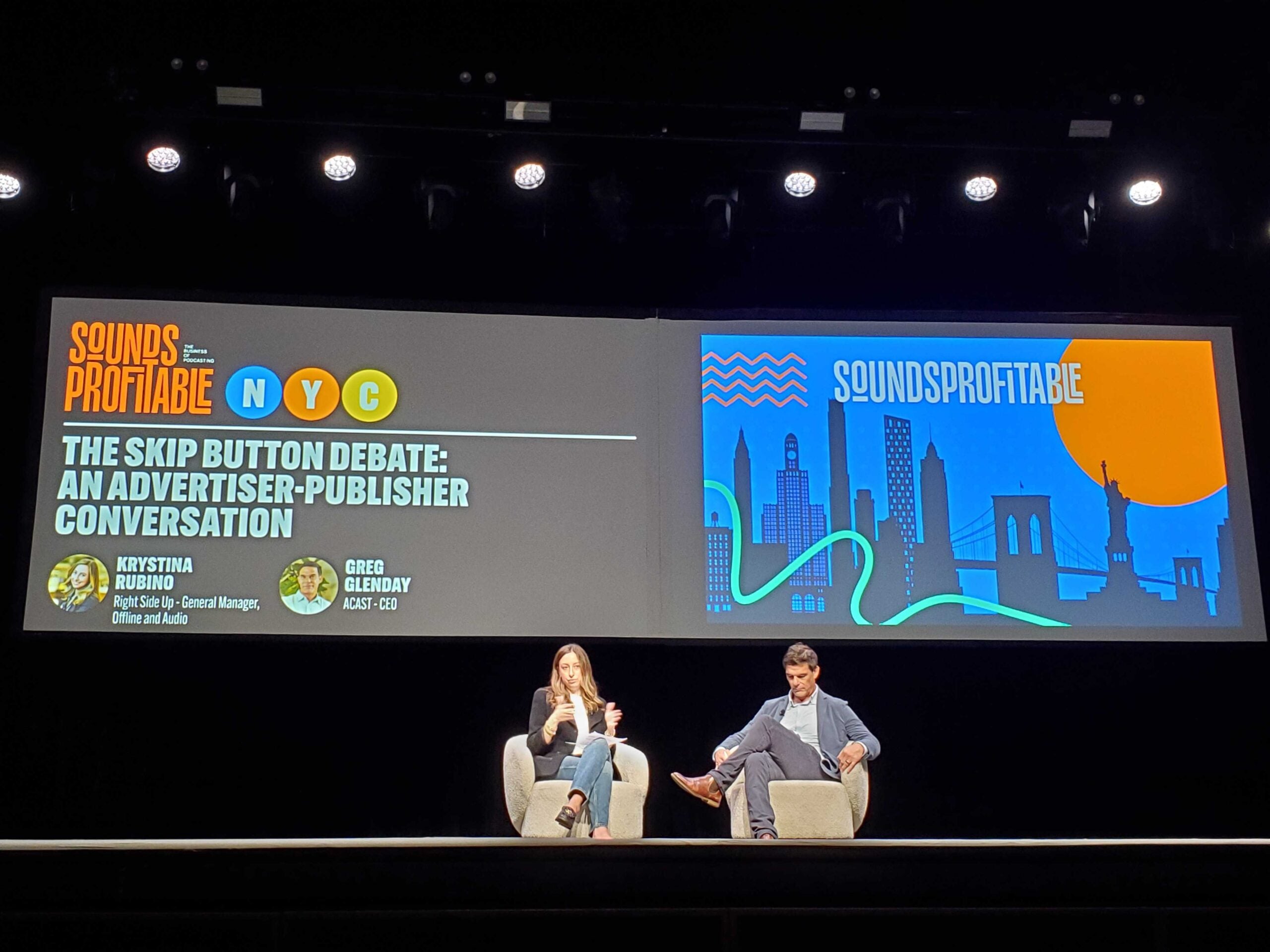
The fireside was focused on the recent news that Spotify is testing a “skip ahead” button that allows listeners to skip ad breaks and podcast intros, which often feature sponsorship shoutouts and other host-read ads. But the discussion highlighted how such a feature is a symptom of a larger problem – that is, podcasts becoming overloaded with ads.
The news of Spotify’s skip button triggered a panic that ad-supported digital audio was doomed, Rubino said. The panic reminded her of the mid-2010s, when digital display advertising adopted viewability standards. That shift caused display advertisers and publishers to hyper-focus on if audiences were likely to see their ads, she said – and to lose sight of whether the ads that still reached consumers were actually performing.
Ultimately, the display market’s embrace of viewability wasn’t the end of the world, Rubino pointed out. And the same will be true for skippable digital audio ads, she predicted.
But, she said, the right way for audio publishers and creators to tackle the skip button conundrum is to recognize that they’ll lose a certain percentage of ad impressions on Spotify, and then to focus on proving performance for the impressions they still deliver.
Meanwhile, Glenday cautioned the audio market against trying to counter the rise of skippable audio ads with more intrusive formats.
“I’m not proud of it, but in 2013, I launched an ad unit at an ad network that was unskippable,” he said. “Internally, we literally called them hostage units because they held the audience hostage. And it was wonderful for ROI, but it was abusive to the listener and it wasn’t a good experience for the creator.”
For a medium like podcasting that trades on audience trust, Glenday added, the margin of error for ad overexposure is even slimmer than it is for traditional radio, which was the industry he started his career in.
“Our program directors used to always say, the listener can vote going 70 miles an hour on I-95, and if you’re abusive to the listener, they can vote and change the station,” he said. “Over time, probably ad loads in radio got a little too high, and because of the way they’re measured, there were no repercussions for abusing that value exchange with the listener. We don’t have that luxury here.”