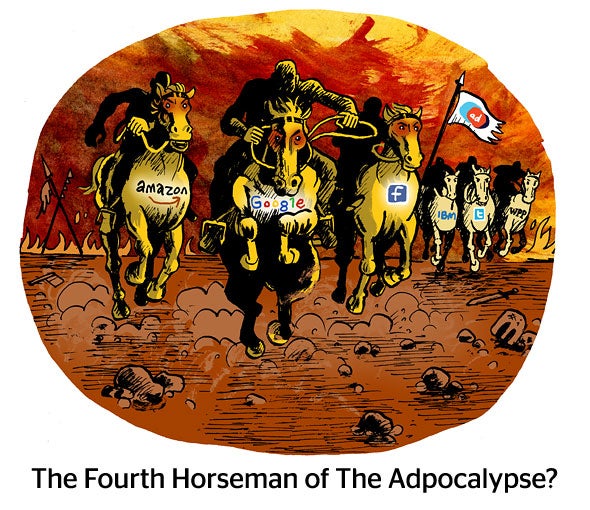
The Million Dollar Sellers group convened last week in New York City during and around Amazon’s own Seller Growth Summit event.
MDS, as the 10-year-old membership-based community of Amazon sellers is known, is probably the closest thing there is to a trade association representing the interests of Amazon sellers, according to Eugene Khayman, a co-founder of MDS. Khayman is a longtime seller and founder and CEO of Amazon-native kitchenware brand Eparé.
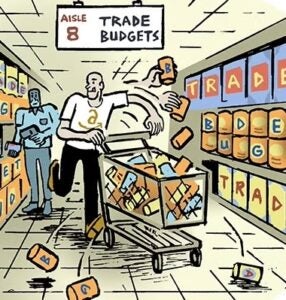
Perhaps you recall “Million Dollars Sellers” or “MDS” from headlines three months ago. At the time, the group’s members boycotted the Amazon ad platform out of frustration with seller margin compression. Specifically, they were ticked off about an ad platform change that would no longer allow accounts to pay for campaigns using a credit card.
The credit card update was punted from April to August 1, granting the organization a minor victory.
However, MDS members have a wide array of concerns. Three Amazon sellers who spoke with AdExchanger last week each separately described the credit card policy reversal – which removes a loophole whereby Amazon sellers earn cashback bonuses and beaucoup loyalty points from ad spend – as the straw that “broke the camel’s back.”

Google and Meta both made the same credit card policy change over the past year. But Amazon sellers are more reliant on the credit card loophole and, until now, didn’t need a bank account to buy ads.
And that’s just one example of how the economics of selling on Amazon are shifting.
Other changes this year include the new DD+7 rule, whereby Amazon pays out for sales only after waiting a full week, as well as “temporary” fuel surcharges, which multiple sellers said they were told will become permanent.
An Amazon spokesperson told AdExchanger in an email regarding the MDS boycott and seller morale concerns that: “We invest heavily in powerful tools, services, and programs to enable their business growth at a cost that is typically lower than alternatives.”
While MDS initially boycotted the Amazon ad platform because withholding ad dollars was the only tool the group could use to exert influence of any kind on a behemoth like Amazon, sellers who spoke with AdExchanger noted that serious ad platform concerns have since crystalized.
These sellers asked to remain anonymous because some are resellers of other products and brands that don’t want to be associated with Amazon strife. Many are also worried about potential retaliation by Amazon.
One seller, an exclusive Amazon reseller of certain name-brand products, said that over the past couple months he’s become infuriated with constant ad platform tinkering and campaign settings that are switched on without his consent. For example, the ad platform will serve ads to Amazon’s off-platform network of websites, which he’s tried multiple times to prevent, he said. Advertisers are also defaulted into serving ads to chatbots, such as promoted placements in AI agents like Alexa for Shopping (formerly Rufus), and into AI-generated creative that puts their ads in new channels, which, again, the advertiser never signed up for, the seller said.
The ad platform has controls to limit off-platform audience extension ads or pause Sponsored Prompts, Amazon’s new in-chatbot ad unit. But “limit” and “pause” are operative words, and the terms advertisers see in the platform. Those ad channels can be diminished or temporarily removed but they must be toggled off for every new campaign. And there are always new tools and features added in the background for advertisers to find and turn off.
Unfortunately for MDS and other sellers, however, Amazon has is not backtracking on any more platform fees or deadlines. Nor is Amazon’s ad platform changing in its progression toward more AI and one-click, end-to-end campaign automation. The plan to move forward with the credit card change at the beginning of August is final, although Amazon has offered sellers $12,500 in ad credits in the first five months to transition their billing.
Khayman told AdExchanger that Amazon execs did commit to more forthright and proactive communications regarding ad platform changes and potential margin compressors, such as additional fuel surcharges, higher required ad spend as a percent of overall sales and warehousing and fulfillment policy changes that pass along greater costs for product returns.
But that’s pretty much it.
Boycott round two?
Don’t hold your breath.
And it is not surprising that MDS members who met together last Wednesday and Thursday displayed a strange mix of emotions.
Many shared internal screenshots of Slack messages showing Amazon executives expressing frustration and concern over their boycott. Others showed emails with Amazon leaders making promises or engaging in velvet-gloved outreach to hear their concerns.
The group is proud of its advocacy – somebody needs to take a stand on Big Tech platform overreach – and pleased that its boycott was acknowledged within Amazon.
But there was also a strong undercurrent of fear.
In terms of affecting Amazon’s revenue, MDS’s boycott is peanuts, which the entire group knows full well. But the word “boycott” is incredibly powerful. There haven’t been any major advertiser boycotts of Big Tech platforms since a months-long YouTube brand suitability revolt in 2017 and the 2020 Facebook boycotts).
But even a relatively small boycott can take on outsized meaning if regulators start paying attention. MDS speaks for sellers in a way that could draw the spotlight of antitrust regulators, which, for Amazon, is the bigger concern than the actual boycott.
Sellers in the org are aware they’ve touched a nerve within Amazon, and perhaps even narrowly avoided some terrible Icarus-like fate by pushing Amazon too hard. The group wants to bring attention to their plight – MDS sellers at the Seller Growth Summit wore hats emblazoned with “SOS (as in, “Save Our Sellers”) on them – but doesn’t want to cross some unmarked line in the sand with Amazon.
For instance, numerous MDS members said they were open to the group considering another boycott at the beginning of August to once again protest the credit card reversal. But one seller – someone who owns and operates accounts with more than $100 million in annual sales on Amazon – observed that “Amazon is just going to kick us off the platform at some point.”
Another cringed at the idea of a second boycott, saying he felt “superstitious” about it, the group having as yet eluded any dreadful “Final Destinations-esque” (his words) comeuppance in reaction to the first occasion.
A third said he feels most comfortable “hiding in plain sight.” In his view, MDS has already made itself a loud antagonist of Amazon, which offers protection of sorts. Any overt punitive actions against MDS would only invite harsher antitrust scrutiny. But he also said that he “wouldn’t want to push it” with a further boycott. There are many ways for the Amazon platform to punish sellers, he added, including just by failing to respond to customer service complaints, like when products or campaigns are suspended for some unknown reason, which happens a lot.
Khayman said he sought legal counsel after the boycott, having been cautioned by friends that he might put himself in a tight spot if Amazon decided to press charges. Recall that X – unsuccessfully as it turned out – sued a consortium of advertisers for allegedly organizing a boycott of its platform, because publishers and advertisers can’t coordinate to gain leverage in negotiations.
The concern among Khayman’s friends is that by leading or coordinating a boycott of sellers he may be vulnerable to a litigious Big Tech opponent with an endless legal tab.
Khayman is clear that MDS’s boycott was by group consensus and required a majority vote. For now, though, the legal and platform disposition risks – combined with MDS’s powerlessness to change Amazon’s stance on any issue – has translated into resignation rather than escalation.
In short, MDS and other Amazon sellers are accepting Amazon’s pinky promises for better communication and taking their lumps in terms of absorbing the costs and fees that were the main impetus for the boycott.
What MDS does next
With further ad platform boycotts highly unlikely in the short term, where do Amazon sellers and MDS go from here?
For most in the MDS group, the short is: “Somewhere else.”
MDS consists of true Amazon seller specialists. The sellers who’ve “only” been selling on Amazon for 10 or 15 years are relative newbies. This is very unlike in the advertising world, where there’s great cross-pollination as people bounce between publishers, agencies, brands and the buy- and sell-sides of ad tech. (As an example of how insular the Amazon seller community is, one MDS member, a longtime seller who did a stint at Amazon before recently leaving to rejoin the seller community, was roundly – and jokingly – booed when he arrived at the small MDS event on Wednesday.)
But despite being set in their ways and their traditional laser focus on Amazon, MDS members and other Amazon sellers who AdExchanger spoke with are almost all testing new platforms.
TikTok is a popular next step for Amazon sellers, though some are increasing their presence on Meta. Others, meanwhile, prefer retailer marketplace add-ons such as Walmart and Target, which now have third-party seller businesses and can also offer their own fulfillment. Two said they’re investing far more in their own dotcom properties, when previously they funneled all of their traffic to Amazon.
“I’d rather do half as much on some other platform” than continue to depend 100% on Amazon, said one seller who manufactures house and kitchenware products. “I just hate Amazon so much at this point.”
And it’s not just anecdotal surveys of one ticked-off seller group. Marketplace Pulse data logged an outright decline in the number of Amazon sellers – from 584,000 to 500,000 between January 2025 and March 2026 – after “a decade of seemingly unlimited supply growth.” Walmart’s third-party marketplace seller count jumped by 50% in the same span.
Although, as an Amazon spokesperson noted to AdExchanger, total third-party seller sales are up year over year, regardless of whether the total seller count is down. The spokesperson also broke out one data point, that “more than 75,000 independent sellers surpassed $1 million in sales in Amazon’s store” in 2025, which was up by more than a third from 2024.
For MDS and other sellers, there are often such wide differences in their particular frustrations with Amazon in part because their low morale right now boils down to one hard-to-quantify fact.
In the words of that same kitchenware seller: “It’s just not fun anymore.”
Another Amazon seller, who’s an authorized brand reseller, suggested that advertisers that feel fed-up with other major Big Tech platforms might also want to try boycotts themselves – just without calling it a “boycott.”
If anything, he said, it will probably demonstrate how “most advertisers can probably pull spend two days per week and it wouldn’t make any difference to their business.”