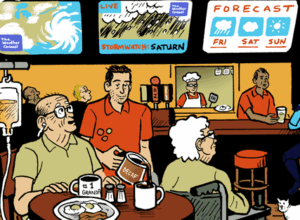

How long does it take you to decide what to watch after you turn your TV on?
According to Nielsen’s 2023 State of Play report, it takes the average viewer around 10.5 minutes. (Put another way, if your TV started playing a random sitcom episode when you turned it on, you’d be halfway through the second act before most other people had even made up their minds.)
This key decision-making time could be an ideal time to reach audiences with ads, as they’re likely to be engaged and looking directly at the screen. However, integrating new ad placements into home screens has been a slow process for TV operating systems (OS) and original equipment manufacturers (OEMs), particularly when it comes to programmatic deployment. Most OS providers, like Roku, Samsung and Fire TV, have strict creative standards, unique technical specs and direct pricing for these placements, none of which is conducive to programmatic methods of buying.
But now that availability and interest have increased, that exclusivity is starting to change. Or, at the very least, it’s getting easier to work around.

Last year, ad tech platform Nexxen began making native home screen ads programmatically available across a growing list of TV OEMs in Europe and the US, starting with V (formerly VIDAA) in September and expanding to include TCL and TiVo Ads.
Originally, these integrations were developed as one-to-one activations, said Nexxen Chief Commercial Officer Kara Puccinelli. Advertisers had to make all of their home screen ad buys separately for each OEM, even from within Nexxen’s platform. They were still able to partake in programmatic benefits, like dynamic pricing, data enablement and connection, but couldn’t consolidate all their buys and scale up across different inventory sources.
On Thursday, after months of beta-testing with clients, Nexxen announced the launch of new standardization tools that will allow advertisers to activate campaigns quickly across more than one OEM. Now, advertisers only have to upload their creative once using Nexxen’s universal spec, and all the formatting gets updated across their system with the use of AI-assisted resizing tools.
As a result, the onboarding time for new OEM partners has dropped by as much as 50% with Nexxen’s universal spec, said Puccinelli. Meaning, the platform is anticipating a lot more home screen inventory availability in the near future.
Using every part of the advertising funnel
Not surprisingly, entertainment brands were early adopters to the home screen ad experience. Given how endemic they are to the larger environment of content discovery, you might not even clock them as ads while you’re deciding what to watch.
But as home screen ads become more accessible – and, more importantly, more measurable – they’re also opening up to a much wider base of marketers and brands.
“What we’ve seen is a big evolution away from just media and entertainment brands being interested in this type of inventory to really opening up to other types of performance-driven advertisers, in addition to awareness-driven advertisers,” said Puccinelli.
Which isn’t to say that CTV is becoming a pure performance play for these types of advertisers. At digital media agency Brainlabs, brand awareness buys seem particularly resonant or even “overrepresented” in their clients’ media mix models (MMMs), said Head of Programmatic Ben Kahan.
“We’re finding more and more that CTV and upper-funnel advertising is being utilized as an effective lower-funnel performative media driver,” Kahan said.
Brainlabs previously worked with Nexxen to buy CTV inventory for a few of their clients but first began discussing home screen ads in February, Kahan told me. At the time, some of Brainlabs’ advertising clients felt they were already saturated in traditional CTV ad breaks and were looking for new ways to reach audiences there. Home screens felt like a perfect fit because, unlike the standard mid-roll ad, they don’t interrupt the content a viewer is trying to watch.
Currently, Brain Labs is testing out Nexxen’s home screen ads with a retailer that’s already seen lots of success with a top-down, upper-funnel approach. How the format’s impact will manifest in the retailer’s MMM remains to be seen, but so far, early results are promising.
Although Kahan said Nexxen did a lot of the heavy lifting for Brainlabs’ first foray into programmatic home screen ads, he also expressed enthusiasm for the potential that more standardization will bring.
“There is definitely huge fragmentation when it comes to these nonstandard formats,” said Kahan. “Having standardization means that we can do better in terms of tooling, and it’s a lot cheaper to operationally stand something like this up at scale.”