

“The strong will survive.”
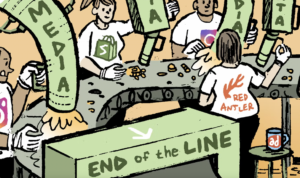
That’s how MNTN CEO Mark Douglas sums up the wave of consolidation sweeping both the media and ad tech industries – and he’s betting his CTV platform will be on the right side of it.
On Tuesday evening, MNTN reported $82.5 million in revenue for the second quarter, up 21% year-over-year. Its active performance TV customer base also grew 40% over the past year, which the company attributes to an increase in small and midsize customers.
As part of that pitch to SMBs, MNTN began expanding their access earlier this year to “premium streaming inventory,” which is the term Douglas used with investors. And that includes live sports.
“We have many customers who advertise during the FIFA World Cup games, March Madness, and on MLB, NBA, NHL and, soon, the NFL,” Douglas said.
AdExchanger spoke with Douglas the day after MNTN reported about what better access to premium inventory means for the business and for CTV advertising writ large.
AdExchanger: How do you define “premium TV inventory”?
MARK DOUGLAS: Premium is episodic programming on TV networks that have scale. We’re talking Disney, Warner Brothers, Paramount, Peacock, Netflix and so forth. All of our ad buys on behalf of our customers go across those networks. We want their ads to be placed on the content people are actively watching, not just playing in the background. The user engagement leads to higher performance.
What we were referring to in our earnings call is even more premium than that. We’re giving buyers guaranteed access, so they can allocate a portion of their budget to live sporting events, for example, or specific reality shows.
That’s something we started to test in Q1. It’s still in beta for us, but we have a lot of customers already taking advantage.
How are you negotiating these premium deals?
We don’t buy open market inventory. We have direct deals with effectively every streaming network in America. I think they view us as a growth channel, because our go-to-market motion is so different from theirs. Their focus tends to be on larger advertisers and ours is on the small and midsize business segment.
How does the demand for live sports inventory impact what you’re able to deliver? Are more publishers setting aside programmatic access that you can tap into?
Absolutely. There’s significant viewing occurring through streaming, and advertisers want the benefits of programmatic ad buying. Programmatic tends to be viewed as being like auctions, but a lot of it is also the signals that are available for real-time decisioning. What we’re saying is that each individual advertiser may not be the size of one of these big brands, but, collectively, their size is large, and so let’s create a solution that’s patterned to them.
This is a solution that’s still in beta, by the way. We haven’t done a formal press release, but there’s a lot of interest in it, so the cat may be out of the bag now.
Why do you think there’s so much interest already?
Our customers are about performance, but there’s also this kind of unquantified halo effect from television – the credibility, the brand association, the ability to create show-specific ads.
Bringing that ability to the small and midsize market is important.
Do you worry at all about the impact that media industry consolidation will have on these types of inventory deals? If all the ad dollars are flowing to one publisher, like Paramount-Warner Bros., what does that mean for platforms like yours?
A big part of our value is that we’ve figured out the SMB market, and that’s not easily replaced even by the networks. One thing I’ve said to many networks is that 95% of our customers have never advertised on TV before. That money was predominantly going to social; not a penny of it was going to television without our platform.
Consolidation doesn’t change that value. In fact, it may increase it, because when you consolidate networks, you’re now on the hook for an even bigger number.
There’s been a lot of M&A on the platform side lately, like Fox and Roku and Walmart and Vibe.co. How do these types of deals in the ad tech space affect the larger ecosystem, and would MNTN sell?
We’re a publicly traded company, so if we were approached, we have an obligation to investors to conduct those conversations if we think it’s legitimate.
In terms of the larger space, I think it’s a “the strong will survive” kind of situation. The consolidation will wind up creating the strongest and likely largest companies that will be the winners. That doesn’t mean the companies that have been acquired are weak in any way, but it’s just kind of the way it plays out.
In the earlier days of The Trade Desk, they had a lot of competition. But as companies got acquired, it left an even bigger space for them to grow into and dominate. The same is true in our situation with MNTN.
Do you have any theories about why bigger companies are so interested in CTV platforms in particular?
It depends on the company. But I think, in general, big media companies are enthused about the SMB market as a growth factor for the overall market.
This interview has been lightly edited and condensed for clarity.
For more articles featuring Mark Douglas, click here.