Here’s today’s AdExchanger.com news round-up… Want it by email? Sign up here.
Ad Tech’s So-Fixable, Unfixable Problems
Gareth Glaser, a programmatic vet and former Prebid.js chair, offers some real talk in the latest edition of his newsletter, “Gareth Hates AdTech.”
He takes the contrarian perspective. In Glaser’s view, open web programmatic is fundamentally good and, although it may be broken, it’s fixable.
He makes the case for a free, open-source, industry-backed website template, and all publishers that opt to use it would be automatically approved to plug into a marketplace of ad exchanges and DSPs. The downward pull on open programmatic CPMs is partly because of how uncertain they are, and an open-source template could fix that.
Consider Meta, which has a terrible and broken advertiser UI yet prints tens of billions of dollars in ad revenue every year because its platforms have scale and its ad placements are reliable (at least in terms of reaching a large number of humans).
Even publishers like The New York Times, NBC or The Washington Post are still just one part of a balanced breakfast while Facebook has the whole buffet. In other words, premium mid-tail programmatic buying has always been a challenge.

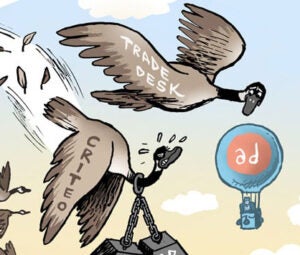
But the web reaches everyone, and if an entity like The Trade Desk were to build a web template like Glaser suggests (hey, it could happen!), the independent internet would grow.
And there’s one other trick the walled gardens are good at that programmatic attempts but never achieves: reliable post-click CPA measurement. Solve that, and advertisers could tie campaigns to actual business results.
TTD’s Fortune 500
Speaking of open internet CPM improvements, The Trade Desk has begun testing a product called SP500+, which is a built-in buying option that confines campaigns to the top 500 publishers on the internet, Adweek reports.
Alongside large news publishers, the tool also pulls in streaming ad sellers, including Disney+, Spotify and Hulu.
SP500+ is different from OpenPath, TTD’s direct-to-publisher product that cuts out SSPs. This + is just the normal DSP setup, but with a whitelist. Publishers don’t even need to be aware they’ve made the cut for SP500+ because it applies to any site that accepts DSP demand.
“We want to be able to say that the open internet on its worst days is better than anything the walled gardens are going to offer you,” says Will Doherty, TTD’s VP of inventory development.
The best way to give meaning to that statement, he says, is to start with the 500 “best publishers.”
Will publishers celebrate, though?
Big media companies generally prefer advertisers use their PMPs and go through their direct sales. This puts top publishers in a potentially large pool of demand alongside fewer fish, but they won’t like risking their direct-sold advertising.
Opening The Gate
The European Commission has shared an update regarding which online services aren’t big enough to be classified as “gatekeeper platforms” subject to regulation under the Digital Markets Act (DMA) taking effect in March, Bloomberg reports.
Specifically, Apple’s iMessage and Microsoft’s Bing search engine, Edge web browser and advertising services lack a “dominant enough position” in their respective markets to be considered gatekeepers under the new rules. In Apple’s case, gatekeeper status would require making iMessage interoperable with other messaging services like Android device messaging or Meta’s WhatsApp.
Apple and Microsoft are no doubt jubilant to avoid being labeled as gatekeepers in these instances.
Still, Apple had already announced support of new cross-platform RCS messaging standards for iPhones, which allow iPhone users to send larger and higher-quality attachments to Android devices compared with SMS messaging (although the much-loathed green bubbles shall remain). Apple made this announcement on Nov. 16 – the same day as the deadline to appeal the Commission’s DMA designation.
But Wait, There’s More!
Walmart is in talks to buy smart TV manufacturer Vizio for more than $2 billion. [WSJ]
Prime Video’s ad tier sparks a class-action lawsuit by subscribers. [The Hollywood Reporter]
Ex-Salesforce co-CEO Bret Taylor and longtime Googler Clay Bavor raise $110 million to bring AI “agents” to business. [Fortune]
OpenAI enables ChatGPT to remember information from past chats to personalize responses for specific users. [Bloomberg]
Days after it broke records for Super Bowl ad revenue, Paramount Global cut 800 jobs. [Deadline]
Meanwhile, Mozilla cuts 60 jobs as it refocuses on AI. [TechCrunch]