Here’s today’s AdExchanger.com news round-up… Want it by email? Sign up here.
Prophesy Unfulfilled
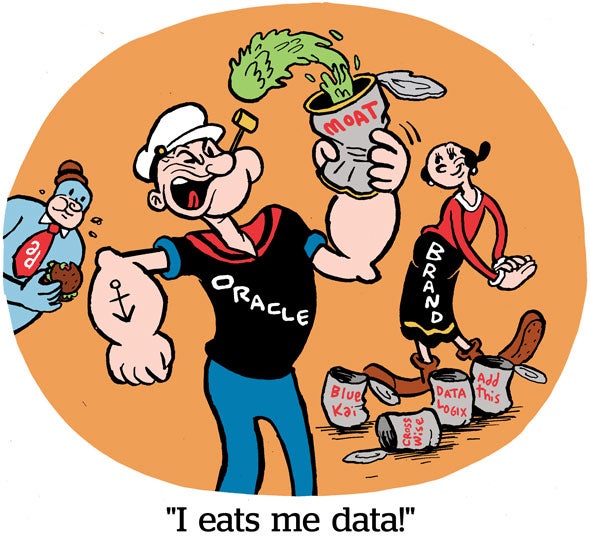
Oracle Advertising, we hardly knew ye.
Moat, we forgot all about you.
Pour one out, because today marks the end of the road for Oracle’s advertising and third-party data businesses, including BlueKai, Datalogix, Moat and Grapeshot.
Retailers, credit card and financial services, TV manufacturers and any other company with first-party data and a claim to captive audiences are betting big on ad revenue. But “first-party data” and “captive audiences” are the important parts. Oracle has neither.

As a data aggregator and only a partner to media companies and retailers, no data or inventory originated with Oracle. When Facebook removed third-party data sellers in 2018, it was “the end of the gravy train,” as multiple former Oracle Data Cloud employees told AdExchanger in June, when Oracle announced it would fold the group by Q4.
Now a new gravy train is in motion. Contextual advertising companies are after the Grapeshot business, while Integral Ad Science and DoubleVerify in particular enjoy an unexpected tailwind. Moat had many blue-chip clients bundled in with the overall Oracle data warehouse.
Digital advertising is a realm of giants. It’s not often the little guys get to feed on a whale.
Wouldn’t Touch It With A 10-Foot Poll
The internet was supposed to be the ultimate political polling tool. Forget pestering people in grocery parking lots; now you have a finger on the pulse of real-time America.
That dream did not pan out, The New York Times reports.
The biggest political pollsters – Pew, Reuters/Ipsos and Gallup – all went big on online, opt-in data. But each abandoned the idea after 2020.
For one thing, digital data is misleading. ZIP codes are an intuitive way to hone respondents by state or district. But that approach turned out to be flawed.
Social media, search and programmatic ads are big drivers of online political surveys. And that opt-in data is often way off, too. Alabama is a highly populated state, per paid media surveys. Probably because it’s atop alphabetical drop-downs. People submit garbage info to jump to the next level of a mobile game or collect some incentive from the polling firm.
“It’s increasingly difficult to say whether and when opt-in polls are worthy of consideration, especially when alternative, traditionally collected data is available,” writes NYT’s chief political analyst, Nate Cohn.
Home mail and landline phones it is. The future is bright.
Happy As A Pig In Slop
The internet has a slop problem.
Not spam or phishing or anonymous trolling or any of the other very real afflictions on the web.
But slop is the term for the recent promulgation of AI-generated stories, posts, pictures and even videos.
At New York Mag, writer Max Read cites the publisher of Clarkesworld, a fiction submission magazine, who saw hundreds of stories come in that were clearly AI-generated slop.
On Facebook, Instagram, X and other social platforms, content that is obviously created by ChatGPT or a similar AI service is shared everywhere. Read speaks to one slop purveyor in Kenya who operates some 170 popular Facebook pages by prompting ChatGPT things like: “WRITE ME 10 PROMPT picture OF JESUS WHICH WILLING BRING HIGH ENGAGEMENT ON FACEBOOK.”
But it isn’t just social feeds built for viral sharing.
Google Books was infiltrated by AI slop. Job and resume boards are swarmed by slop. And the AdExchanger team can assure you that many PR firms are turning to generative AI to craft pitches. Not one is convincing or compelling.
But Wait, There’s More!
What was said, and what was really meant, at the DOJ vs. Google ad tech trial. [Digiday]
Google’s ad tech monopoly defense is widely criticized by industry experts. [Ars Technica]
For Wall Street deal makers, the billion-dollar bangers are back. [Business Insider]
Ryan Reynolds’ ad platform has teamed up with Morgan Stanley for its IPO. [Bloomberg]