Cup Holders
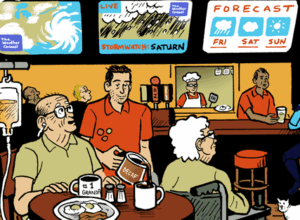
The success of this year’s FIFA World Cup has network rivals competing to swipe the broadcast rights away from Fox and NBCU’s Telemundo.
Netflix, Disney and YouTube are angling to air the 2030 and 2034 tournaments, CNBC reports. Amazon, which broadcasts the UEFA Champions League, and Apple, which has global MLS rights, could enter the fray.
Notably, FIFA has signaled that the English- and Spanish-language broadcasting rights could be sold together starting in 2030. That would be a reversal from FIFA’s historical practice of splitting language and market rights.
One reason to sell the rights together is that there’s been tension between Fox and NBCU over splitting the audience – and ad revenue.
For instance, many English speakers watched the Telemundo World Cup broadcast to avoid Fox’s advertising during each game’s two mandated hydration breaks. Plus, a Peacock/Telemundo subscription costs $9 less than Fox One.
Although the next two tournaments will have a hard time matching this year’s World Cup on overall ad revenue due to time zone differences with the key US market. (2030 is taking place in Spain, Portugal and Morocco, and 2034 will be hosted by Saudi Arabia.) So maybe it makes sense not to split the pot.
A Loyal Steward
Warner Bros. Discovery is further committing its ad tech to Amazon Web Services, its “preferred” cloud infrastructure provider.
WBD announced an agentic integration using AWS during Cannes last month, which it’s now followed up with a full-fledged, end-to-end ad tech stack rebuilt around autonomous AI (AWS’s AI, specifically).
So far, this agentic ad tech suite handles “direct response and commercial workflows, advanced audience forecasting, and enhanced measurement and attribution,” per an AWS blog post.
WBD’s plans to add key components in the standard programmatic stack later this year. In Q3, the entertainment giant plans to release a product for “unified media planning.” (After all, WBD’s whole raison d’être here is the convergence of linear and online television.)
After that, sometime in Q4 2026, the plan is for a “phased rollout” of point solutions for composable order management, pricing and stewardship.
The most interesting word in the entire blog is “stewardship,” which is (maybe?) a euphemism for when an AI product is given full hands-on management, as it were, for media buys and campaign optimization.
Spheres Of Influence
Marketers of all stripes have rapidly adopted vendor tech to help understand how and when their products appear in generative AI searches.
The practice, known as GEO (generative engine optimization), although sometimes also AEO (answer engine optimization), involves a vendor collecting data by submitting the same prompts (“What’s the best running shoe for a new runner,” or whatever) thousands of times to see how the LLM responds. And tracking that over weeks and months.
The amount spent by marketers on GEO tools partly reflects marketers’ actual helplessness to influence how often the major LLMs surface their products and how their brands are described.
But the explosion of GEO tracking has meant an unexpected spring tide of influencer brand sponsorship deals for content creators who, usually by fortunate happenstance, are commonly cited or recommended by the likes of ChatGPT, Claude and Google’s AI Overviews.
One creator was interviewed about his experience with eczema on HealthCentral, a site that documents stories of chronic diseases, as Adweek reports.
Post-interview, ChatGPT began surfacing his name when brands searched for recommendations of creators who post about eczema. Those followers in turn brought deals from Cetaphil, Hypothesis, O’Keeffe’s and MAGS Skin, cosmetics brands with products for people with eczema.
Brand inquiries grew 50%. Actual followers, however, were more slow to trickle in, though he did count a 1.5% increase in his TikTok following.
But Wait! There’s More!
The New York Times’ top editor explains why its new push into video is a “race against time.” [Business Insider]
Corporate America finally buys into soccer as a mainstream sport; shadier elements of the ad industry are obliging. [Digiday]
A new browser extension called Knockoff will dim or blank out knockoff products and “sketchy” brands on Amazon’s feed. [404 Media]
You’re Hired!
Power Digital appoints Charlie Chappell as president of its CPG division. [release]