Take The Wheel
In June, Comcast made waves by announcing it would spin NBCUniversal into a separate public company (while retaining a fifth share of ownership for its first year).
One lingering question has been what will happen to FreeWheel, Comcast’s TV and video ad server. The ad tech unit would make sense as part of either NBCU or Comcast proper.
But that question’s now resolved: FreeWheel will go with NBCU when the new company lists on the stock exchange next year, tipsheet.ai reports, citing internal Comcast communications.
“With advertising at the core of NBCUniversal, we believe closer alignment with ad technology will accelerate FreeWheel’s mission on behalf of the premium video ecosystem,” FreeWheel writes in a blog post confirming the news.
The cynical take is that Comcast has tasted the programmatic ads business and is spitting it back out. There’s plenty of precedent for that, actually. It’s basically what happened at AT&T (Xandr, we hardly knew ye) and during Verizon’s ill-fated Yahoo takeover (recall Yahoo’s proposed spin-off as Oath and the cringeworthy “Take the Oath” tagline).
But Ari Paparo – who sold the DSP Beeswax to FreeWheel – tweeted, “I think the opposite. NBC really wants to own tech as part of their overall stack.”
Getting There
Retail media is oversaturated with standalone platforms. Cue the consolidation speculation.
Big global brands like Coca-Cola or Hershey that are sold everywhere log into hundreds of retailer interfaces whose data they can’t get elsewhere. Some of these long-tail retail media networks are contested by Criteo and other ad tech vendors.
But the top of the market is primed for blockbuster consolidation swings. The Trump administration is lenient if not borderline indifferent to acquisitions that might have drawn challenges by previous FTCs or DOJs. Kroger and Albertsons probably wish they’d waited on their disastrous failed merger.
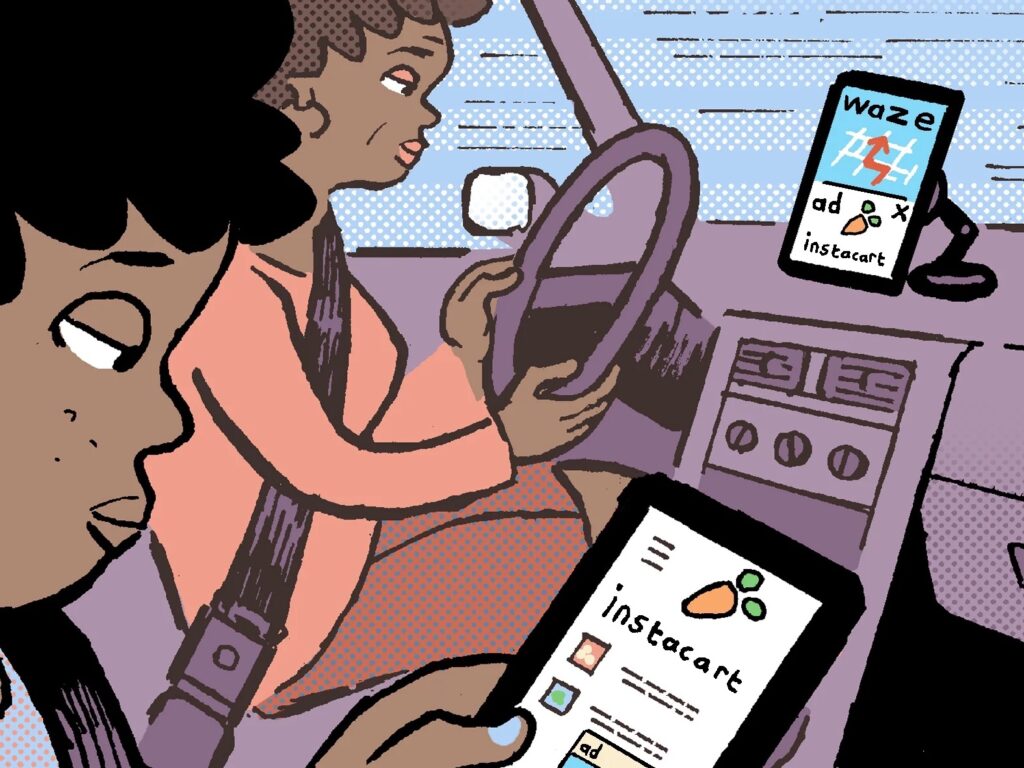
Given this environment, The Information’s report that Instacart is up for sale makes perfect sense. Instacart has reportedly been in talks with Uber and DoorDash, though apparently Uber has walked.
DoorDash previously considered an Instacart acquisition back in 2021 when the grocery delivery service was ad-free and a private venture-backed startup. Instacart was valued between $40 billion and $50 billion back then, whereas its public market cap is now $12 billion.
An acquisition by either DoorDash or Uber would consolidate a major niche in last-mile delivery and retail media margin-ification. Uber launched its ad biz in 2022 and surpassed a $1 billion run rate by 2024. DoorDash had its first billion-dollar ad year last year.
Too-Smart TVs
A viral post from this weekend is reigniting consumer fears that smart TVs are spying on us.
An X poster by the name log4j, who claims to be a cybersecurity researcher, says they reverse-engineered the code behind their $3,000 Samsung TV using ChatGPT and other decompiling software.
The hack revealed what log4j sardonically refers to as “PRIVACY HORROR”: an always-on mic that listens for barking dogs or crying babies. It then reports back to Samsung to better serve you ads.
Adding fuel to the conspiratorial fire, log4j shared an email from OpenAI notifying them that their account was suspended for “Cyber Abuse” – invoking fears of Big Tech companies circling the wagons.
But rather than something shady happening behind the scenes, the features are actually hyped in some of Samsung’s consumer marketing, Tech Radar reports.
Samsung touted its listening tech as “family and pet care” that notified different devices if a loved one seemed in distress. Although Samsung apparently discontinued the baby-listening feature last month after it couldn’t tell whether a baby was crying on TV or in real life.
Of course, Samsung could have made it clearer that it’s sending the data to its servers, and for what purpose, Tech Radar notes.
But even consumer-facing features can take on a sinister light in the public’s eyes when they’re associated with surveillance advertising.
But Wait! There’s More!
Pinterest names Magnite as its preferred SSP in new programmatic integration. [Adweek]
Microsoft offers voluntary buyouts to 60,000 employees, more than a quarter of its total headcount, as it cuts costs to balance its AI investments. [CNBC]
Big retail and restaurant chains with known data collection practices (think Walmart, McDonald’s, Kroger, et al.) are dealing with angry customers who believe prices are being manipulated algorithmically. [WSJ]
The NBA names Kalshi and Polymarket as its official prediction market partners and expands its existing partnership with DraftKings. [ESPN]
Lawmakers are looking into the way that DraftKings, as well as other online gambling companies, use AI and behavioral data to target customers based on their previous losses. [NYT]
Anthropic publicly files its S-1, an early step toward its IPO. The company is expected to be valued at $1.5 trillion or more. [The Information]
Meta is expanding its video repertoire and ambitions for TV as it plays catch-up with YouTube and TikTok. [Bloomberg]
Here’s today’s AdExchanger.com news round-up… Want it by email? Sign up here.