Continuing The Search
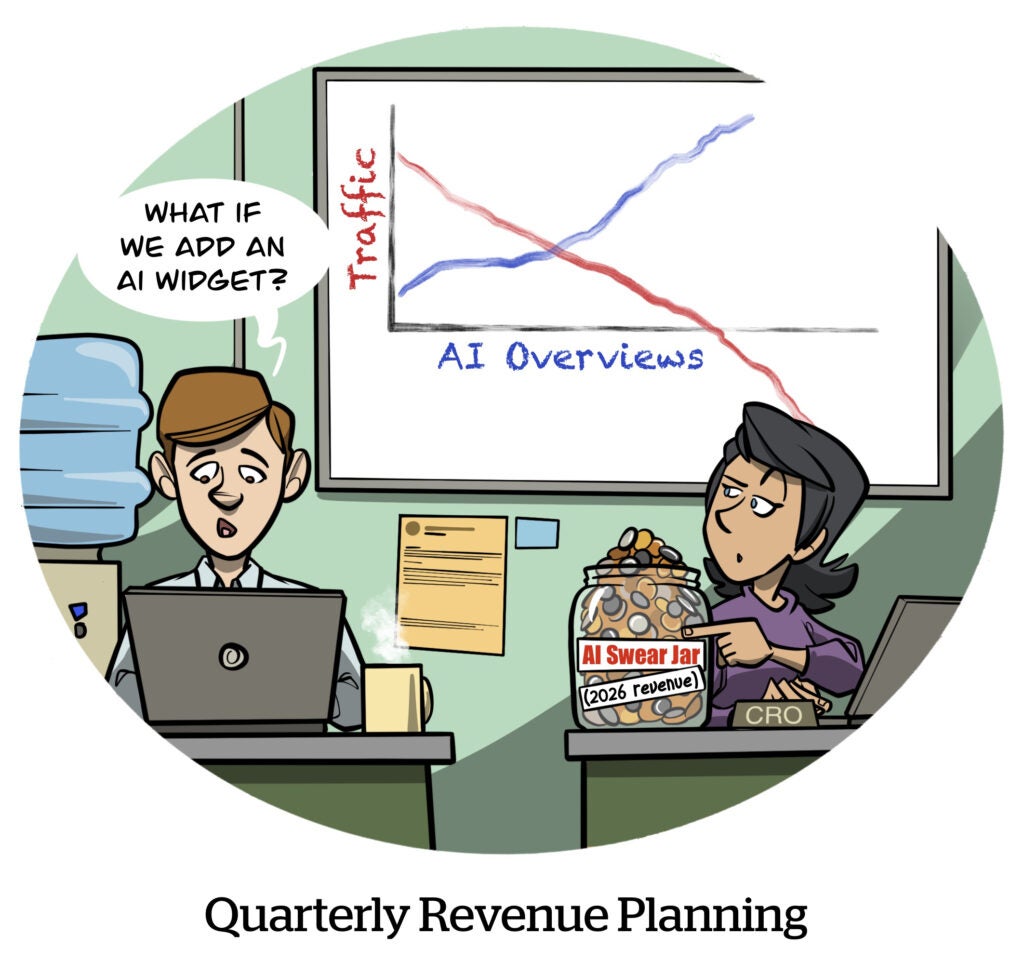
Although People Inc. CEO Neil Vogel recently said that blocking all Google scrapers is “entirely on the table,” the publisher apparently isn’t ready to go that far, at least not yet.
During the company’s Q2 earnings call on Tuesday, Vogel told investors that Google Search – which relies on the same crawler as AI Overviews – accounted for 21% of its traffic last quarter, down from nearly two-thirds. “We’re not out the other side of it,” he noted, which is just another way to say that People Inc., like so many other publishers, still needs Google to make money.
Despite what VideoWeek describes as a “steep decline in traffic,” People Inc. managed to keep ad revenue flat year-over-year by packaging inventory on its sites with offsite content, such as live events and social media.
Part of the reason People Inc. says it can hold the line on ad revenue is that quality inventory is getting harder to find in a sea of AI slop and declining traffic. As a result, demand – and prices – for premium content are on the rise.
Put It In Drive
With great horsepower comes great responsibility.
That’s the lesson for BMW, which is running a first-of-its-kind campaign featuring in-car Spider-Man takeovers. The ads will run through August 10 – unless the backlash becomes overwhelming – and include a pop-up that drivers can tap to trigger a Spider-Man animation on the center console screen, plus sound effects and even “an accompanying light show courtesy of the ambient lighting system,” according to BMW’s press release.
The campaign will be available to experience in BMW vehicles produced after July 2020 that run the most recent BMW operating system. (Our condolences to those owners.)
The movie tie-in is part of a broader brand deal whereby other BMW models are featured in the new Spider-Man movie. One was even driven onto the red carpet at the film’s Los Angeles premiere, a BMW spokesperson tells auto industry pub The Autopian.
All that red-carpet fanfare would be one thing if it stopped at the theater.
But the BMW iX3 costs more than $62,000 at a base level, plus $1,300 per month for subscription features. So even though you can click away the Spider-Man promo, the forced distribution feels like an affront. This isn’t a YouTube homepage takeover or an ad-supported streaming tier.
For some car owners, the Spider-Man in-car ads no doubt feel less like a harmless bit of movie marketing and more like their car has been quietly turned into ad space.
A Different Beast
Digital creators are becoming media owners, for better or worse.
Many influencers are setting up their own platforms and side businesses to better monetize their strong followings on YouTube, Adweek reports. YouTuber MrBeast, for example, operates a multibillion-dollar empire, and comedic duo Rhett & Link built one of the earliest creator-led media production companies.
The economics make sense. According to eMarketer, advertisers in the US are on track to spend at least $21 billion this year on creator partnerships and brand deals – nearly twice the projected 2022 total.
But established media and entertainment companies also want their share of those creator-driven ad dollars. Streaming services represent an opportunity for creators to get their content in front of new audiences, and Hollywood studios want to capitalize on the success of creators who make their own films.
Still, the blurring line between the media and creator economies is causing friction, Digiday reports. Production studios attempting to monetize creator-led content are finding themselves in legal battles over IP ownership, while creators themselves must become experts in the unsexy aspects of running a media business.
No wonder more and more YouTubers now speak fluent ad tech. They basically have to in order to get paid.
But Wait! There’s More!
The rise of AI search is pushing influencers to think less like creators and more like media businesses. [ICYMI]
The antitrust trial on the Paramount-Warner Bros. merger is scheduled for March. [WSJ]
Teads files a lawsuit against Google and parent company Alphabet in a New York district court, seeking damages following the recent ruling that exposed Google’s monopoly over online advertising. [release]
You’re Hired!
Mobile entertainment company Zully names Matt Montemayor as its EVP and head of sales. [release]
Digital marketing agency New Engen adds Nik Hengel to lead advanced analytics and measurement strategy. [release]