Took It To the MAX
Another legacy brick-and-mortar giant launched a retail media network.
Snooze.
Except, there is an interesting angle this time. By which I mean yesterday’s news that RE/MAX, a real estate brokerage and listings company, is launching an off-site audience network atop Magnite.
It’s funny because RE/MAX is truly brick and mortar. But also because its SSP integration shows how companies can unlock surprising potential pools of retail media revenue.

At first glance, bread-and-butter advertisers for RE/MAX would be real estate brokers or agents who have homes for sale or are prospecting for potential home buyers.
But RE/MAX’s data is chockablock with consumers who are entering “one of life’s most important decision-making windows,” as per Stephanie Reustle, Magnite’s head of commerce media, from the release. Big insurance, mortgage, finance and grocery brands, which might not make intuitive sense for RE/MAX media, are in fact prime potential advertisers.
Similarly, when Macy’s launched its off-site retail media network on The Trade Desk’s pipes in 2023, one of the main draws was the fact that Macy’s and Bloomingdale’s (which Macy’s owns) are popular for baby and wedding registries.
For these retail media companies, there is a huge hidden upside for non-endemic advertisers, who can target a specific and decisive moment in someone’s life.
Stopping The Flo
In case there wasn’t enough discourse about infringements on reproductive rights, the period-tracking app Flo has retaken the spotlight.
On Monday, Meta lost a class action lawsuit brought by users of Flo, TechCrunch reports. The app users alleged that menstrual health data – including period dates and cycles, as well as fertility goals – had been collected and used for ad tracking without their consent.
Also, a month ago the health and wellness digital publisher Healthline paid a $1.55 million settlement with the California attorney general to avert a lawsuit regarding its alleged ignoring of opt-out requests for ad tracking.
Meta says the class-action trial’s decision was wrong.
“The plaintiffs’ claims against Meta are simply false. User privacy is important to Meta, which is why we do not want health or other sensitive information, and why our terms prohibit developers from sending any,” says a spokesperson.
A jury took the other side of the argument.
In another example of the collision between Meta and health data, hospitals and health care providers have been rethinking their use of Meta pixels. Data that feels commonplace and nonsensitive in one place can morph into a violation of privacy when it is modeled and extrapolated by ad platforms or appended to a profile for potential targeting purposes.
Get In, Loser, We’re Going Streaming
The IAB Tech Lab just proposed a set of standards to help streaming platforms improve ad delivery during live events.
It’s called the Live Event Ad Playbook, or LEAP. (Which is a major improvement from their recent mouthful of an initiative: the “LLM Content Ingest API Initiative.”)
The first phase of implementing LEAP is the Concurrent Streams API, which provides insights into how many viewers tuned in to a livestream at any given moment. This allows publishers to “send live viewership data to ad systems, enabling faster ad decisions and reducing the risk of missed ad breaks,” TV Technology reports.
Advertisers can use this data to adjust campaigns to seize on significant moments as they unfold. Like targeting, say, sports games that are going into overtime.
Whatever TV content they’re watching, US viewers are mostly watching it by online streaming, says IAB Tech Lab CEO Anthony Katsur. And as live events hop on the streaming bandwagon, the Tech Lab wants to ensure that “advertisers can act on high-impact opportunities without sacrificing the viewer experience.”
But Wait! There’s More!
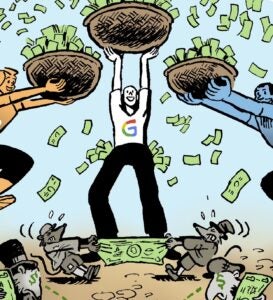
Advertisers complain bitterly about Google traffic and ads, but they can’t quit. [The Information]
Roku launches its own $3 per month AVOD streaming service, dubbed Howdy. [USA Today]
Singular becomes first MMP to launch ChatGPT MCP integration. [release]
Kantar surveyed 1,000 Americans to find out what they think of the “good jeans” American Eagle ad campaign. [The Drum]
We already know one thing: Trump liked the American Eagle campaign. His praise of the Sydney Sweeney ads coincided with a 24% jump in the clothing brand’s share price on Monday, although it fell by about 9% the following day. [WSJ]
Nielsen and WPP have struck a new audience-measurement data agreement. [Variety]
OpenAI, Google and Anthropic are being added to the US government’s list of approved AI vendors. [Bloomberg]
You’re Hired!
Outfront Media hires Jim Norton as CRO, Enterprise, Mark Bonanni as CRO, Commercial, and Brad Alperin as head of brand solutions. [release]
Thanks for reading AdExchanger’s Daily News Roundup. Want it by email? Sign up here.