What Now?
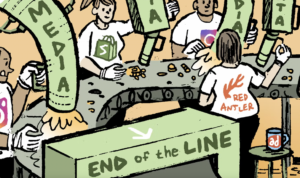
Cable network MS NOW, previously MSNBC, launched a subscription app this week at $7.99 per month or $79.99 annually.
News media has struggled to find its place in the mobile subscription economy. (CNN+, anyone?)
Behemoths like Walmart, Uber and Amazon commonly bundle their offerings with entertainment studios and other content providers, but never with pure news publishers. Netflix avoids news programming like the plague.
But MS NOW is trying to break that pattern. It’s got its own marketing bundle-partners, including a deal with meditation app Calm, for instance, Variety reports.
And beyond bundling, MS NOW is also leaning into direct engagement as a hook. One unique selling point is that its subscribers get regular live Q&A access to news anchors ahead of their shows, including before Rachel Maddow’s weekly Monday program and the “Morning Joe Family Meeting.”

Given the likely small subscriber base and the fact that only a fraction will join any given live Q&A, the feature effectively gives a handful of superfans a direct line to inform or even shape those programs.
Inviting subscribers into the editorial process is a fresh conflict of interest. Then again, the old editorial/advertising firewalls are already eroding now that marketers and Big Tech platforms treat news as a political and brand-safety liability.
An Axe To Grindr
LGBTQ+ hookup app Grindr prides itself on its anonymity and discretion.
So it’s not exactly a great look that the company will now pay $35 million to settle a UK lawsuit alleging that it sold user data – including HIV-positive status – to advertisers.
The lawsuit covers the period prior to Grindr’s 2020 acquisition by investment group San Vicente Acquisition LLC. It claimed users believed their personal information would only be shared internally with app users, but was instead sold to ad targeting companies including Localytics and Apptimize.
Grindr’s current VC ownership denies any wrongdoing and is admitting no liability as part of the settlement, CBC reports. However, the company says it “recognizes and acknowledges the distress and loss of trust expressed by some of its UK users regarding that pre-2020 period.”
“Distress and loss of trust” is putting it mildly. The idea that sensitive data – such as a person’s LGBTQ+ status or health information like an HIV diagnosis – could be shared with third parties without their consent is an oft-cited hypothetical nightmare scenario. Well, it happened.
But Grindr is only just the latest example of a company allegedly (gotta say “allegedly!”) playing fast and loose with user data when there’s money to be made, and then paying a hefty fine to avoid further scrutiny. Unfortunately, it won’t be the last.
Taking The L(G)
Just a few months after reporting that some LG monitors push unwanted ads to users, PC hardware review outlet Gamers Nexus now claims that LG television sets are able to record audio from the on-device microphones if hacked in a particular way, The Verge reports.
According to Gamers Nexus, which partnered with Level1Techs and independent security researchers, LG TVs can scan Wi-Fi networks for nearby devices and location data, and record microphone audio even when they’re on standby or disconnected from the internet.
The investigation also cites LG’s automatic content recognition (ACR) technology, which uses audio and visual signals to identify what’s playing on a screen.
ACR is nothing new. Most modern smart TVs use similar technology to identify the content and commercials people are watching, although outside of the ad tech industry, the majority of casual viewers have never heard of it.
This investigation is changing that, which could prove awkward for LG. The Gamers Nexus YouTube audience may have been largely unfamiliar with ACR before, but they’re savvy enough to be outraged by its privacy implications.
But Wait! There’s More!
OpenAI CFO Sarah Friar wants ChatGPT’s ads business to be like “if Google and Meta had a baby.” [Business Insider]
Agencies react to the FTC’s suit against Amazon alleging that the platform illegally manipulated its ad auction – and their response is a near-unanimous “meh.” [Digiday]
The Department of Homeland Security operates a predictive policing unit that analyzes the financial data of Americans and feeds it to local police so they can pull over anyone the government thinks is worth searching. [404 Media]
Despite rolling out new AI detection tools, Meta has let hundreds more CSAM ads run across its platforms – including some with photos of real children. [Wired]
In related news, Meta’s history of privacy violations and lack of consumer trust might hurt adoption of its new Muse AI assistant. [TechCrunch]
You’re Hired!
Commerce media platform Fluent names Jeanniey Walden as CMO. [release]
“Decisioning economics” startup Precise hires Dave Antonelli as CRO and Jordan Cauley as CTO. [release]
Multicultural media and marketing company My Code appoints a new CRO, COO and CFO. [Adweek]
Thanks for reading AdExchanger’s Daily News Roundup. Want it by email? Sign up here.