
 “Data-Driven Thinking” is written by members of the media community and contains fresh ideas on the digital revolution in media.
Today’s column is written by Simon Harris, head of programmatic activation at Dentsu Aegis Network.
Each fall, Apple releases a new iPhone with the promise that it’s the best iPhone ever.
This year’s iPhones are very much iterative. One of the features that Apple has upgraded is Intelligent Tracking Prevention (ITP), a feature that first launched last year in its mobile browser Safari. ITP prevents users from being tracked by ad tech businesses across the web, and thanks to some upgrades, the latest iPhones will be the least trackable ever.
These changes will have a massive impact on marketing in the United States because of Apple’s dominance in its home market. Globally, Google Chrome is used by around 55% of mobile internet users, but in the United States, Safari is the dominant force with a 50% share of browsers. Even worse for marketers, most older Apple devices are upgraded to the latest software quickly, as we can see for iOS 11:

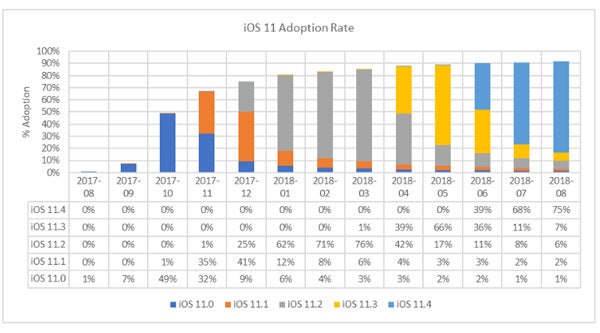
Global stats, September 2018 (Source: statcounter).
In fact, initial stats show that iOS 12 is being downloaded even more quickly than iOS 11, meaning the revised and more aggressive version of ITP (ITP2) will likely be installed on most devices just in time for the holiday season. This means we could see a tipping point where ITP2 is installed on more than three-fifths of iOS devices by Black Friday and three-quarters of iOS devices by Christmas.
The first version of ITP, which launched with last year’s iPhone X and iOS 11, partitioned off the cookies used by ad tech companies to track potential customers across the mobile web after 24 hours. For advertisers, this reduced the scale of remarketing audiences and drove conversion rates lower as key ad tech players struggled to deal with the new technology.
How is ITP2, featured in the version of Safari that ships with the iPhone Xs, more aggressive? It eliminates the 24-hour grace period, and the workaround solutions proposed by many ad-serving businesses, including Google, for iOS 11’s iteration of ITP will not work for ITP2. That means that many remarketing pools won’t just shrink, they will dry up.
The impact on attribution is to be determined, but there’s the potential for the conversion rates that fell under the original version of ITP to crash under ITP2. Tracking solutions that set a first-party cookie as a way to circumvent the original version of ITP will struggle to measure under the revised iteration, because now the domain where a cookie is set will be required to have a user interaction, like a click, in order to be stored. Apple’s announcement about ITP2 changes at the end of Q2 seems to have blindsided many key players in this space who are now playing catch-up.
The impact of ITP2 will be felt well beyond remarketing and attribution. Another new feature aims to curtail “tracker collusion,” which will make it difficult for ad tech vendors to sync cookies. This vital process allows advertisers and ad tech companies to build match tables so they can understand that a user from one vendor is the same in a different database. This has the potential to limit marketers’ ability to leverage audience data to target their buys effectively.
While some key players have been caught flat-footed by Apple’s changes in the short term, I’m confident that in the medium term these ad tech businesses will be able to work through tracking, measurement and attribution challenges in a privacy-compliant way. Until then, this may be a shot in the arm for opportunities away from web-based advertising, such as in-app advertising and email, which don’t rely on cookies.
Follow Dentsu Aegis Network (@dentsuaegis) and AdExchanger (@adexchanger) on Twitter.








