 “Data-Driven Thinking” is written by members of the media community and contains fresh ideas on the digital revolution in media.
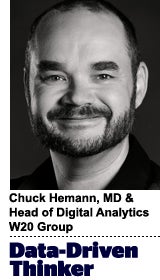
Today’s column is written by Chuck Hemann, managing director and head of digital analytics at W20 Group.
Today marketers are expanding their analytics budgets exponentially with the desire to determine return on investment (ROI). A recent CMO survey found that brands expect to increase their spend on analytics by a factor of five.
There are at least three things that caused this explosion in research and analytics in the past 15 years. First was the rise in new media – specifically digital media and new forms of social and paid media – and rapid adoption of mobile devices.
Second, we’ve seen growth in the number of available data sets that allow brands to evaluate marketing success and understand who their audiences are at a much deeper level.
Third, and usually the most underrated, is the growth of research and analytics talent. Despite advances in machine learning, automation and artificial intelligence, humans are still what make the insights engine go around and are critical for success.

With the growth in talent, data and desire to understand ROI also comes a flood of questions from marketing and communications executives about how to staff and structure research and analytics function.
The answer is more complex than hiring a bunch of data scientists and calling it a day. It requires a diverse set of skills that match the growth in channels and data sources to leverage marketing as the center of customer insights within organizations.
When structuring internal research and analytics teams, brands should hire or train analysts who know paid, earned, shared and owned media disciplines because they can better evaluate channel effectiveness, help ongoing optimization and inform marketing planning. Understanding these media disciplines at a deeper lever will enhance insights to be more actionable, which leads to better execution.
Brands should hire market researchers. As the growth of digital media and social listening took off, so did the discussion around the death of market research. Several brands claimed to reduce investment in market research in favor of digital analytics. Ten years later, there is a surge in the need to have strong market researchers on staff because while digital analytics can be used to understand behaviors, there will always be an audience that can’t be understood fully.
And there will always be value in market researchers validating the behaviors playing out online. This is an increasingly important function, and one that should be integrated with digital analytics capabilities to solve client questions.
Brands shouldn’t overlook marketing technologists. What does it take to deliver great insights? Platforms and people. Scott Brinke’s 2018 marketing technology landscape report found that the number of tools used has grown to almost 7,000. That’s an overwhelming number, and it reinforces the importance of investing in people to develop insights. Marketing technologists are essential in connecting the data pipes needed to understand the complete customer journey and fuel activation. Without them, data is analyzed in a silo.
Of course, a research and analytics teams needs data scientists. Data science is one of the essential functions needed to support large marketing programs and the business at large. These individuals are critical to developing the right data models to take wildly different data sets and turn them into something meaningful.
Finally, brands need analytics strategists.
There is an increasing need to identify senior analytics professionals who know the disciplines enough to guide and deliver insights back to the business. At first glance, this might feel a bit redundant. However, if the intention is to service the entire business and not just an individual channel, it’s essential.
There needs to be someone to understand the audience and apply the learnings to several use cases, not just media targeting. This person should understand how messages are being received so that there can be a continual loop to the team developing content. An individual who can speak sales and understand the interplay between channels to drive more customers into and down the funnel is key.
The number of members that brands will need on their teams is entirely dependent on their organization, but these skill sets should all be represented under one umbrella.
Follow W20 Group (@W20Group) and AdExchanger (@adexchanger) on Twitter.