
 “Data-Driven Thinking” is written by members of the media community and contains fresh ideas on the digital revolution in media.
Today’s column is written by Ari Paparo, CEO at Beeswax.
“Ad tech is like Taco Bell: the same seven ingredients combined in hundreds of ways” – unknown
Look, there’s nothing new under the sun. But that doesn’t stop entrepreneurs from finding new niches and ideas in the ad tech market. Despite the headwinds, the advertising market is extremely large, and despite the negativity of investors, there remains a healthy appetite for M&A activity of all sizes.
There’s an interesting dynamic among ad tech startups, where the business models sought by investors diverge from those that are easiest to execute and fastest to generate revenue.
Investors and acquirers have a preference for software-as-a-service (SaaS) models, with repeatable, predictable revenue and long-term contracts. But those kinds of contracts are much harder to secure than more transactional media or CPM-based deals.


Let’s review the business models that have been successfully used over the past two decades, along with the pitfalls and gotchas they have for both new entrants to the ad tech market and technology buyers.
Take It Easy: Media Or Percentage Of Media
Charging a percentage of media is by far the easiest way to gain adoption as an ad tech vendor. This can either be disclosed, or bundled with the media and nontransparent. The percentage-of-media model has several advantages as a pricing scheme. It:
- Aligns with usage
- Is very agency-friendly
- Can appear ‘free’ when bundled into a media line item
- Is easy to understand
However, this pricing scheme comes with certain problems for both the vendor and the customer. On the vendor side, you’ve got a totally unpredictable and cyclical revenue stream, which can be shut off at the whim of the agency. For this reason, investors hate percentage-of-media models.
For customers, percentage of media has a fairly obvious baked-in conflict of interest. The vendor makes more money when customers spend more money, not when they get better results. The effects of this conflict are less obvious for agencies, since they are also often incentivized to maximize spend, but as marketers bring vendor selection in-house, the percentage-of-media model will puzzle procurement teams to no end.
The Old-Fashioned: CPMs
You can’t get more basic than flat CPM pricing. From the earliest days of ad serving, tech vendors have used CPM-based pricing to allow costs to scale with volume, while avoiding the price-based variability of the percentage-of-media model. A flat CPM model:
- Aligns with usage
- Aligns with vendor costs
- Is agency-friendly
- Is easy to understand
CPM-based pricing has a major disadvantage for vendors: Customers inevitably ration their usage to lower costs. This may seem counterintuitive, but as soon as a customer knows they are being charged $0.0X incrementally on every ad-served impression or data management platform record, they start making decisions about which impressions are worthy, and which data is really important enough to record.
If you don’t believe this, ask yourself how many marketers use their ad server to run their affiliate banners?
Style Points: The Cross Subsidy
My personal favorite model is the publisher subsidy. This was most famously prevalent during the ‘Rich Media Wars’ of the late 2000s, when vendors like PointRoll and EyeBlaster claimed their technology was ‘free’ to buyers, since publishers were paying for it. A form of this has recently re-emerged with demand-side platforms offering “fraud-free” guarantees that are actually paid for by the sell-side.
The beauty of the subsidy model is the everlasting truth that publishers will do anything for a buck. So any tech that helps publishers get more revenue can be exploited by a savvy vendor into a back-door way of getting a fee. Other pros are that:
- It really appears to be ‘free’
- It’s agency-friendly
The drawback is obviously the misalignment it can cause between the buy and sell sides, as the hidden fees need to be recouped elsewhere in the relationship. For the vendor, it can also be a dead-end relationship that devalues what the tech offers – if a customer considers the vendor to be a free pass-through, it is near impossible to gain traction for upsells. Nothing is free, kids.
Looking Smart: SaaS With Bands
From a vendor’s perspective, SaaS is an ideal but quite challenging business model. The challenge is that costs for ad serving, data and the like are high and variable, so a flat SaaS fee exposes margin risk. Further, switching from a variable model to a flat model is nearly impossible, as existing customers will seek substantial discounts commensurate to the risk they are absorbing with recurring fees that are independent of usage.
The middle ground solution for many ad tech vendors is a SaaS-like model that includes annual contracts and flat fees, but regulates usage within a predictable band of impressions or spend. Go over the band, and you need to renegotiate the contract. This model has a very different profile from some of the others, in that:
- Vendors and their investors like it
- It is easy to budget for, which CMOs like
- It removes seasonality and spikes in costs
- Usage is much less constrained by incremental costs
And in contrast, the negatives of this model are that:
- Agencies can’t predict when customers will use it
- No one likes overages
- Vendors generally need to take some margin risk
- It is difficult to work with highly seasonal businesses
The True Believer: SaaS
Finally, you can run a true SaaS model with pricing that is flat or based on components, seats or another use-related factor. The reality is that this model really doesn’t work for most ad tech companies that are part of the serving stack since there is too much variability of usage. The only true SaaS companies have been analytics or data vendors with pre-packed data sets available on a per-seat basis.
Summary
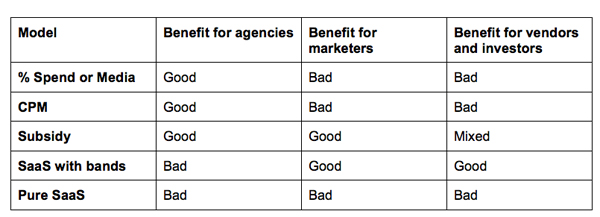
The markets ultimately dictate the pricing models that make sense for buyers and sellers. But the clear push across the board is toward transparency and, increasingly, flat or fixed costs. SaaS-like models are more predictable for vendors and can result in greater investment in products and services. The more variable ad tech pricing structures, while easier to understand, can often obfuscate costs and, ultimately, erode margins.
Follow Ari Paparo (@aripap), Beeswax (@BeeswaxIO) and AdExchanger (@adexchanger) on Twitter.








