
 “Data-Driven Thinking” is written by members of the media community and contains fresh ideas on the digital revolution in media.
Today’s column is written by Ming Wu, chief revenue officer at MightyHive.
The digital advertising industry is afflicted by seven deadly sins, six of which are common themes in the industry: ad fraud, viewability, ad blocking, transparency, privacy and ad tech fragmentation.
The seventh sin is reach and frequency.
Reach and frequency are the currency of all advertising but measurement can be grossly misleading. As marketers gain more visibility into their campaigns, they should be asking more questions.

The marketer’s ‘rule of seven’
Speaking of seven, remember “the rule of seven” that marketers used to rely on? It stated that people needed to see your marketing message seven times before it has a material effect. Now we know it’s more of a range between six and 10 times.
Let’s say you’re a brand manager who wants your online ad campaigns to reach 25 million target consumers, with an ideal frequency of seven ad exposures per user in 30 days.
No problem, your agency or marketing team tells you. Off they go to run the campaign, later returning to report that reach was close to the target, and the average frequency was approximately seven. That may conjure up something like this ideal impression distribution:
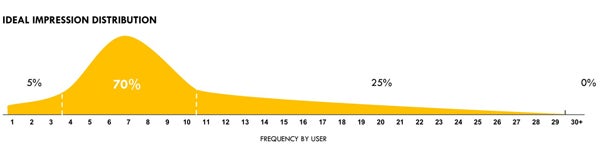
However, if you ask to see the raw user-level data – it’s a lot of effort, but worth it – you will get a very different picture (see below).
Many users were reached only once or twice. Most advertisers would say those impressions were a waste of money because there was no recall or conversion.

On the far end of the curve, we see where 50% of the impressions and media dollars were spent. These ads hit people more than 30 times in a one-month period, or more than 90 times per quarter. What’s equally disturbing but not shown in the graph is that these 50% of impressions typically are concentrated on only 18% of the audience —when the marketer’s desire is to have it be more evenly distributed.
Younger adults ages 18-29 are most likely to go online “almost constantly,” according to the Pew Research Center. Did the advertiser really mean to reach this subset of “super users” so many times? Probably not. Plus, these are likely the most vociferous critics of annoying and intrusive ads – and who can blame them?
Few ad impressions hit the sweet spot in the middle of the tennis racket – the rest bounced off the rim.
The publisher’s perspective
Publishers must balance monetizing their inventory and distributing impressions to advertisers across reserved and auction buys. They can’t give everyone the best inventory and users because there aren’t enough to go around.
I know of one major publisher that has roughly 10% of its users generating 90% of all impressions. Most publishers have no choice but to show ads once to a lot of users and then use the minority of loyal readers to deliver campaigns in full. The revenue hit to the publisher would be devastating otherwise. Every publisher would love to have both reach and frequency, but it is an elusive goal for most given today’s content consumption behavior and the way content is distributed and shared socially.
When advertisers buy across 10 or 20 publishers or more, each optimizing for themselves and not for the advertiser, this reach and frequency problem is further exacerbated.
Shining a light on frequency in the era of control
Advertisers are demanding more programmatic control, with some going so far as to take their programmatic in-house. Others rely on programmatic guaranteed, deal IDs and other features to better manage reach and frequency.
But more needs to be done to master the problem. Most of today’s algorithms were written for acquisition marketing and direct response, not branding, exposure and messaging over time. Technology companies in the ecosystem need to be challenged to rewrite their algorithms to optimize toward ideal frequency and steer away from reach based on just one or two impression exposures. Rewriting algorithms requires significant resources and new forecasting tools, so few are willing to do it but it’s time.
It should be a wake-up call when companies such as Procter and Gamble cite frequency capping challenges as one reason for slashing their digital ad budgets. But capping overexposure is only half the problem: We also need to better predict which users will see an ad campaign once and be able to increase the frequency for them. We also need the ability to not show some users the ad at all, so advertisers’ dollars aren’t wasted on those impressions, either.
CMOs and media buyers alike need to stop this seventh deadly sin of digital. It’s time to shine a light on the issue. It’s been a sin of omission for too long.
Follow MightyHive (@mightyhive) and AdExchanger (@adexchanger) on Twitter.







