“Data-Driven Thinking” is written by members of the media community and contains fresh ideas on the digital revolution in media.
Today’s column is written by Maja Milicevic, co-founder and principal at Sparrow Advisers.
How often have you heard something along these lines?
“We’re looking for a highly strategic chief revenue officer (CRO) who can help with building out the organization, in-market credibility and opening up new lines of revenue. We also want to make sure this is someone who rolls up their sleeves and goes out and sells every day.”
I can hear those of you in ad tech and mar tech sales cringing. While this may, at first glance, sound like a great challenge for an ambitious leader, it’s really a tell-tale sign that the person who wrote this description needs to go back to the drawing board.
Companies often conflate their needs and don’t separate the necessary business skills and experience (such as the ability to open doors with strategic clients) from the functional part of the role (someone is needed to go out and sell).

Important nuances
This problem manifests itself differently at different company stages: While larger companies (including each of the end-to-end marketing suites) typically have a well-honed sales process, their challenge may be to adapt the team’s skill sets to a rapidly changing environment.
Smaller companies and companies in rapid growth mode often make the mistake of prematurely hiring a CRO – usually a former senior individual contributor from a large, well-established company – without first laying the foundation for such a critical leadership role and building the director and VP layer.
There is nuance on what type of experience you’re looking for in an incoming sales executive; the needs of a business that monetizes through an annual recurring technology subscription (SaaS) are different than those of a business that relies on upsells and continually increasing media spend for growth. The SaaS company would need someone comfortable with longer sales cycles, building out connections between sales, sales engineers/services and product and investing heavily in presales. The latter needs a leader skilled in growing existing business and likely an investment in the account management team as well.
In any case, a CRO needs to be able to work across departments and balance long-term strategy with supporting individual teams and achieving short-term (quarterly) goals. Depending on the company’s size and focus, that can require very different approaches.
Avoiding the most common sales team mistakes
Sales role job descriptions and sales levels are often murky, especially in smaller companies where a skilled negotiator may talk their way into a higher-level role and better compensation without necessarily having the right mix of experience.
Here’s a basic breakdown of what skill sets are needed at different role levels in a sales organization and the typical title and level that matches them:
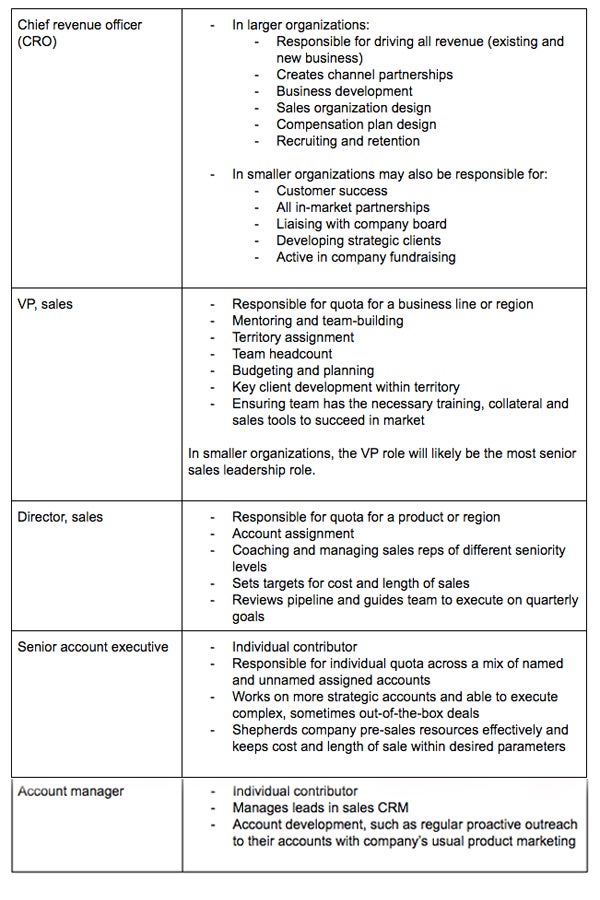 While I don’t like to describe any role in binary terms as either tactical or strategic, the roles at the top half of this framework focus more on longer-term (six or more months out) and companywide challenges. Those occupying the bottom half have a very clearly set, execution-focused, quarter-by-quarter mandate.
A company’s stage and business focus creates different levers to pull. An ad tech, mar tech or commerce technology provider that’s rapidly scaling, for example, can ensure it’s avoiding bloat in its sales team by beefing up its presence in-market and hiring more junior and senior sellers, capping off at the sales-director level while working with a consulting strategic CRO to help design its sales organization and compensation plans, while also ensuring alignment across sales, marketing, client success, finance and product.
A publisher may want to bring in new directors and VPs to build out and reinforce key client relationships, develop longer-term strategies and engagements and forgo the CRO role altogether. There is a tendency in market to hire the most senior executive as soon as possible; this approach doesn’t leave much room for a poor candidate fit, as a CRO or VP-level hire who doesn’t work out can have a drastic effect on the company’s entire annual revenue.
This role framework will be useful for candidates, too, especially those earlier in their careers or those wanting to transition from managerial roles to individual contributor roles (or vice versa). Give it a shot and see how it applies to your current organization.
The more we understand the differences between companies and can articulate expectations for incoming roles, the better off the digital advertising industry will be. Perhaps the worst situation is when you find a candidate you like but the role is not defined at the right level, and their expectations of what they’ll be responsible for vs. what was discussed in the interview aren’t met after onboarding.
Replacing a hire who didn’t work out is not only a costly process, but in sales roles it can have a paralyzing effect on the rest of the company and your in-market momentum, over a relatively short period of time. Being clear, both internally and externally, about what you need will go a long way toward building a well-oiled sales team and will make your interview process more structured, too.
Follow AdExchanger (@adexchanger) on Twitter.