
 “Data-Driven Thinking” is written by members of the media community and contains fresh ideas on the digital revolution in media.
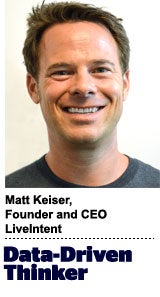
Today’s column is written by Matt Keiser, founder and CEO at LiveIntent.
Oracle’s new ID Graph uses the company’s data to match unique identifiers to its BlueKai data-management platform (DMP). That means unique identifiers associated with email, mobile and customer relationship management (CRM) can attach to the BlueKai DMP in an anonymized manner, creating its own translation layer that can enable measurement and attribution.
BlueKai has cookie-synced with everybody and can move data to nearly any service provider. However, it did not have anonymized PII or unique identifiers that would allow it to onboard CRM data and offline data, which together comprise the Oracle ID Graph (the translation layer).
This innovation makes it possible to connect CRM data and offline data to BlueKai’s connectivity. This data can link to any brand, network, publisher, demand-side platform or supply-side platform, not just to Facebook or Facebook Atlas. The Oracle ID Graph also lets you bring the data back to your own attribution model or CRM database.

This is the holy grail that the industry has been searching for – and a warning shot to Salesforce’s marketing cloud.
A Solid Facebook Alternative
The Oracle ID Graph or translation layer will prove immeasurably valuable because it offers brands a true alternative to Facebook Atlas where they don’t lose out on their data.
Oracle asserts it doesn’t want a walled garden.
Brands already have a bad taste in their mouth from Facebook recruiting them to its platform only to hold them hostage and forcing them to buy advertising to be seen. Requiring brands to hand their data over to Facebook for one-way use in Facebook’s walled garden was another annoyance. This one-way relationship stopped brands from closing the loop.
Oracle is now letting advertisers bring the same cross-platform and cross-device utility that Atlas offered without restricting that utility to Facebook by combining the BlueKai cookie graph and anonymized identity graph, which I believe is derived from DataLogix, Responsys, Eloqua and other third parties.
This combination creates the Oracle ID Graph and helps Oracle customers to move CRM data wherever they want while also allowing them to map their exposure data back for online and offline attribution. Brands can onboard this data onto AppNexus or MediaMath and then take that data back and append it to their databases.
Facebook doesn’t allow this. Combine this capability with Oracle’s DataLogix, which allows connecting purchase and in-store data, and you’ve got the holy grail.
People-based Marketing Needs Attribution
This portability of data and ability to leverage it is central to the future of marketing because these concepts and the tenet of people-based marketing become more crucial in a mobile world.
People spend more time looking at mini screens than TVs, but few like buying on their phone. With mobile ad spending expected to reach $100 billion by 2016, or 51% of the digital market, mobile will still only account for a quarter of all ecommerce.
The biggest challenge has been gauging whether mobile advertising works if it didn’t directly drive sales. You couldn’t tie them together. That’s the grand prize.
Everyone knows mobile works but no one knows how, an addition to the classic Wanamaker adage, “Half the money I spend on advertising is wasted; the trouble is I don’t know which half.”
In mobile, you’d be lucky to get half. Oracle could provide invaluable insight for brands and advertisers.
A Shot Across Salesforce’s Bow
Oracle’s move is a warning shot to Salesforce’s marketing cloud. DoubleClick was dominant for as long as most anyone can remember. Facebook Atlas was the first solution to get buy-in from the industry because of the value of its inherent translation layer.
Salesforce invented the marketing cloud and everyone knows it has a lead, but it is not infallible. Oracle wields a translation layer ax that can bring Salesforce to its knees if it meets no resistance.
But Salesforce has some pretty amazing pieces lined up to defend itself if it chooses to, including ExactTarget and Pardot, which are key pieces to the puzzle but not the entirety of it.
From what I can tell, Salesforce has not prioritized building a translation layer to connect the ecosystem to shopper data, which would be a Datalogix equivalent.
Will Salesforce Relent?
Will Salesforce, one half of a famed rivalry, sit by as its chief competitor Oracle gobbles up all the assets it needs to build everything that brands want?
I doubt it. Marc Benioff has transformed a quirky marketing cloud startup into the idol of every entrepreneur by being bold, thinking ahead and acting strategically aggressive.
I predict Salesforce will take notice and begin acquiring the pieces necessary to build its own translation layer. It will gird for battle with Oracle, which Google failed to do when Facebook acquired Atlas in 2013.
The era of underestimating your rival is over. And no company is more competent in devising ways to win than Oracle’s closest competitor, Salesforce.
Expect More Battles for People-Based Supremacy
Now that we know how Facebook Atlas works, its recipe has essentially been published. As everyone races to recreate it, we must evaluate everyone’s likelihood of success based on their history and reputation for competence.
We’re watching a battle of two of the most brilliant companies out there, but I foresee Salesforce offering a counterpunch the likes of which Oracle has never seen.
The question is: What will that battle strategy look like?
Follow Matt Keiser (@mrkeiser), LiveIntent (@LiveIntent) and AdExchanger (@adexchanger) on Twitter.








